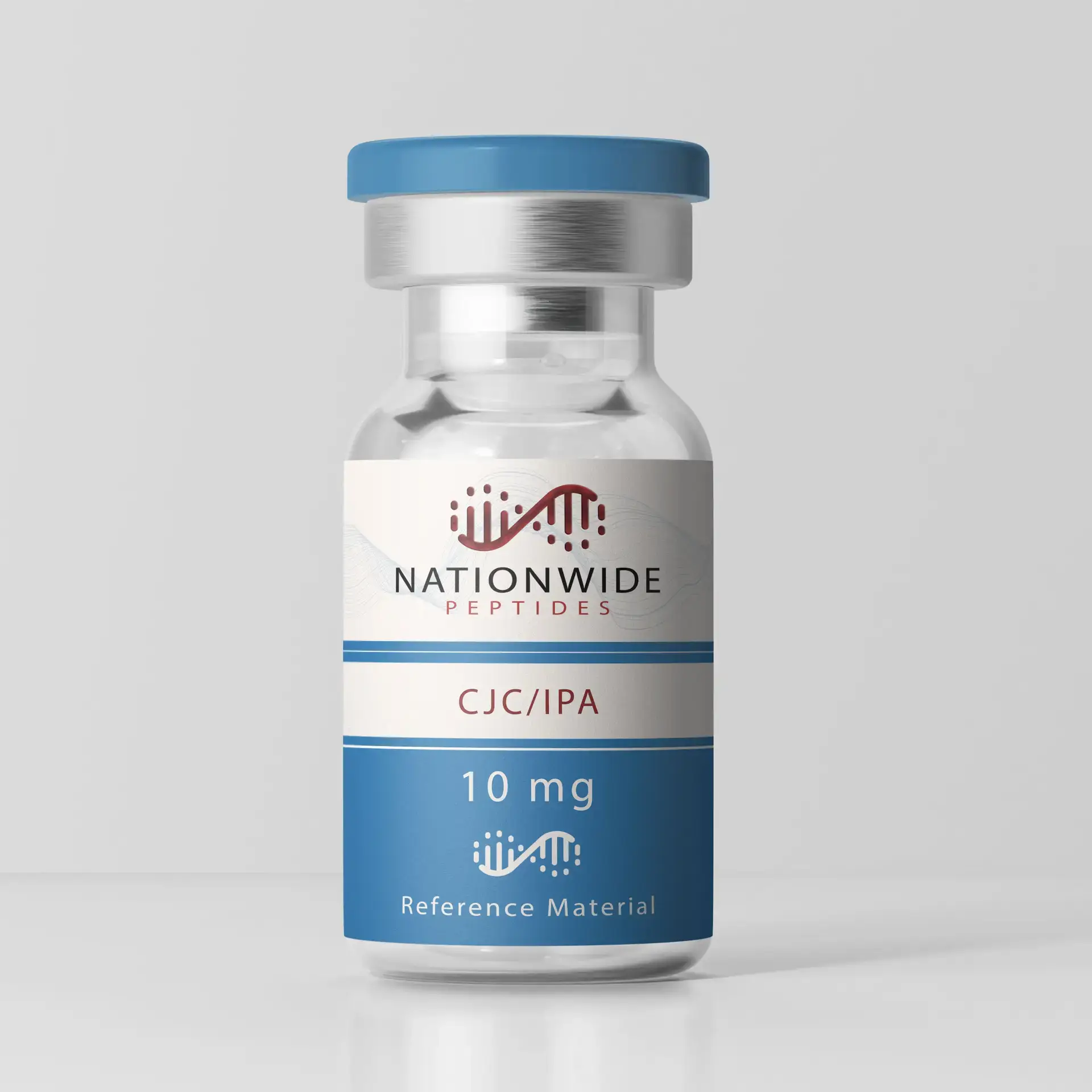
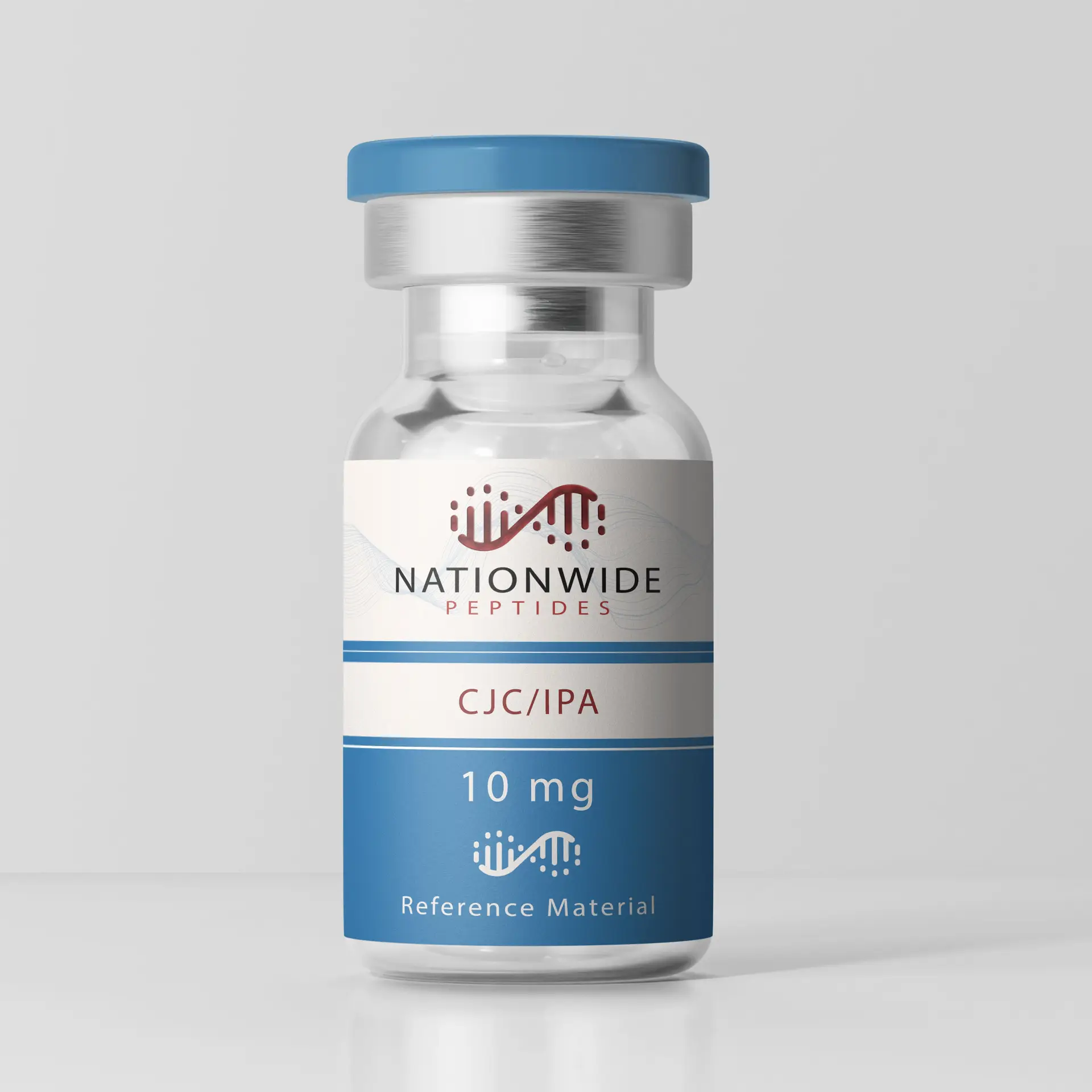
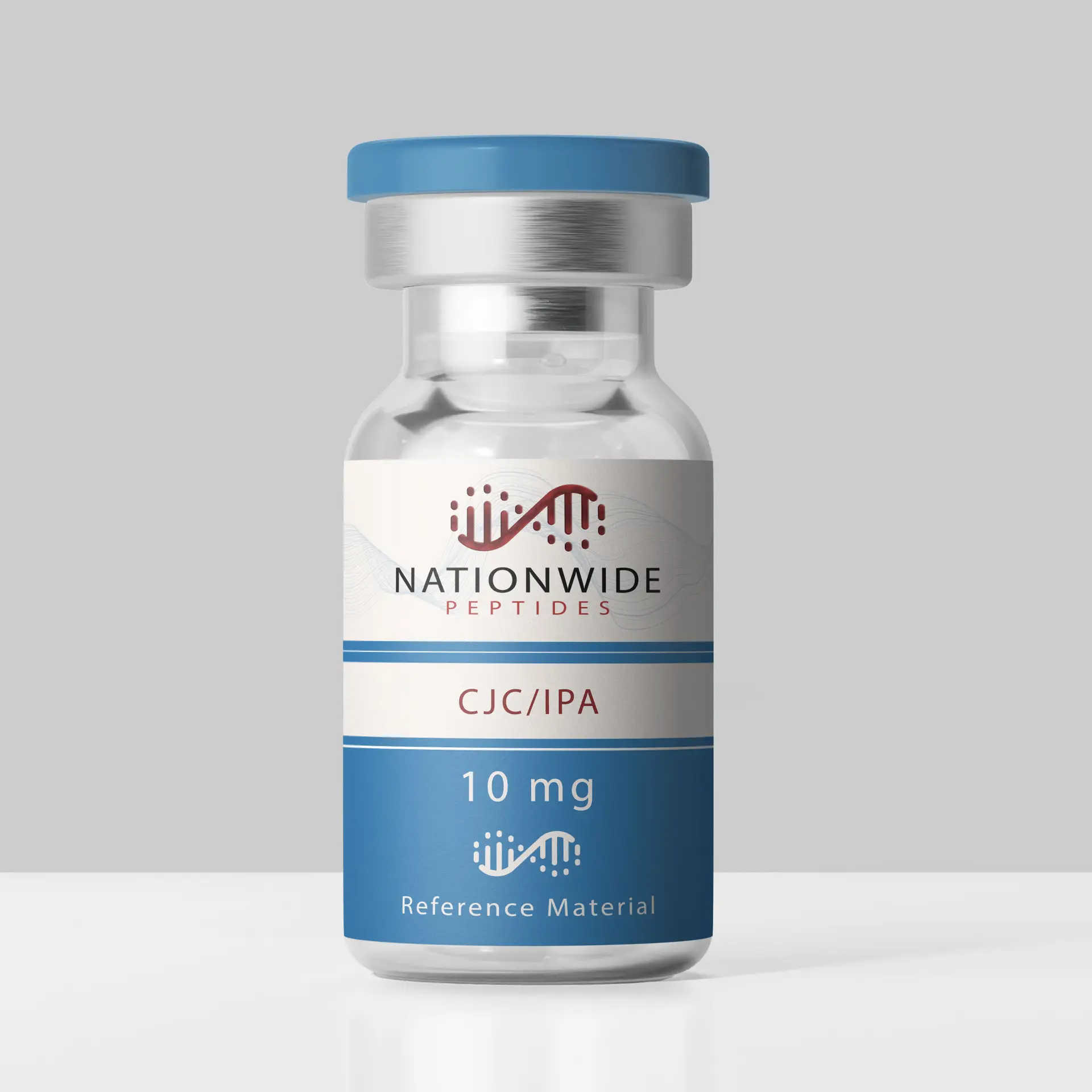
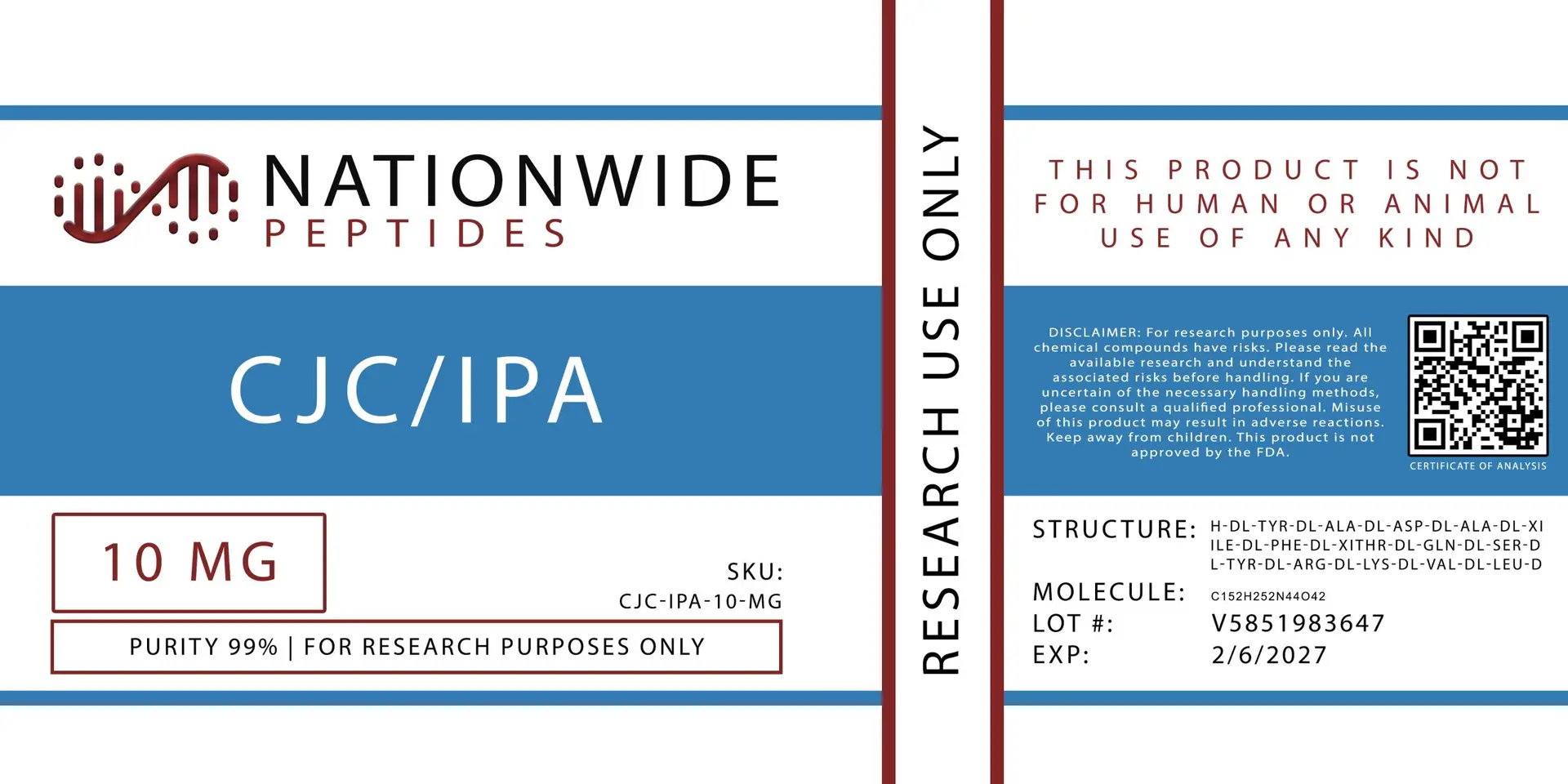
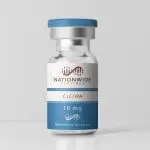

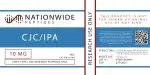

CJC-1295 + Ipamorelin Blend research-grade
CJC-1295 + Ipamorelin Blend
$62.00 Add to cart

CJC-1295 + Ipamorelin Blend

$62.00

Laboratory-grade CJC-1295 + Ipamorelin Blend is a co-packaged GHRH analog and selective GHS pentapeptide for GH-axis co-administration studies. Research buyers select this listing for pre-clinical work on dual secretagogue pathway models—not for clinical, veterinary, or consumer use.

For Research Use Only. Not for human use.
In stock

For Research Use Only — Not for Human Consumption
Free shipping on all orders over $200 (US)

  • 99% Purity – Third-Party Tested
  • Fast & Reliable Shipping
Guaranteed Checkout

Accepted Payment Methods

For Research Use Only. Not for human use.

CJC-1295 + Ipamorelin Blend research-grade

Overview

Laboratory-grade CJC-1295 + Ipamorelin Blend presents as a co-packaged GHRH analog and selective GHS pentapeptide for GH-axis co-administration studies. Nationwide lists this SKU for controlled research programs focused on dual secretagogue pathway models—not for clinical, veterinary, or consumer use.

Research buyers specify CJC-1295 + Ipamorelin Blend when protocols require a characterized input for dual secretagogue pathway models. Typical deployments include cell-based or cell-free assays, method development plates, and pathway-mapping models executed under institutional laboratory SOPs.

Use this entry when laboratory purchasing needs a stable research SKU for assay construction and notebook traceability. All handling of CJC-1295 + Ipamorelin Blend must remain inside institutional research-use boundaries.

Research Context for CJC-1295 + Ipamorelin Blend

Work involving CJC-1295 + Ipamorelin Blend typically focuses on in vitro systems, assay development, and mechanistic model studies.

Teams confirm lot details before setup so conditions stay traceable across repeats and collaborative sites.

Published literature can inform starting ranges for related experimental designs. Each laboratory should still validate performance with its own instruments, plates, and detection chemistry.

Pilot runs are useful before committing larger plate sets, especially when detection chemistry or incubation windows are being optimized.

Documented Attributes

Key catalog attributes for this material include:

  • Research-grade material intended for laboratory investigation only
  • Catalog labeling aligned with research procurement channels
  • Suitable for method development and comparative assay workflows
  • Documentation packages available where provided for the listed lot

Laboratory Handling Notes

Receiving and Identity Checks

Before opening a vial of CJC-1295 + Ipamorelin Blend, confirm the physical label against the purchase order and packing list.

Retain outer packaging until identity checks are complete, and report damaged seals to purchasing before experimental work continues.

Reconstitution and Aliquoting

Handle this material according to institutional SOPs for weighing, reconstitution, aliquoting, and storage.

Record lot identifiers in laboratory notebooks before reconstitution. Verify solvent compatibility and storage temperature against your validated process.

Prepare assay buffers and consumables before opening the vial to reduce hold time. Keep unused aliquots labeled with date, solvent, and concentration for later repeats.

Chain of Custody

Keep chain-of-custody notes with inventory checks when material moves between freezers or benches.

Use dedicated spatulas and clean balances to avoid cross-contamination between catalog items. Schedule thaw cycles intentionally rather than repeated freeze-thaw of the same aliquot.

Secondary containment trays reduce spill risk during multi-step reconstitution. Cold-chain interruptions should be noted even when the vial remains sealed.

Why Laboratories Source CJC-1295 + Ipamorelin Blend

Procurement and research teams often select this catalog item because it supports:

  • Clear research-use labeling for compliance-aligned purchasing
  • Consistent product identification across multi-lot studies
  • Fit for reference, screening, and mechanistic laboratory models
  • Straightforward catalog support for planning and documentation

Study Planning and Quality Documentation

Before starting experimental work with CJC-1295 + Ipamorelin Blend, review any COA or quality files provided with the shipment.

Align your protocol with institutional research requirements and keep use within the labeled research context.

File catalog documentation with the study records at receipt. These steps help keep experiments comparable over time when using CJC-1295 + Ipamorelin Blend in sequential study phases.

Method Development Tips

Method development often begins with small pilot plates before larger screening panels.

Document buffer lots, incubation times, and detection settings alongside the material lot number.

If results diverge from historical baselines, re-check reconstitution volume and storage history first. Shared equipment logs help explain variance when multiple operators run the same protocol.

Inventory and Training

Update digital inventory immediately after opening a new lot of CJC-1295 + Ipamorelin Blend.

Training new staff on labeling conventions reduces mix-ups across similar catalog SKUs. When transferring methods between sites, share both the written SOP and the lot metadata package.

Dispose of residual solutions according to institutional chemical hygiene rules. Do not repurpose research materials for any non-laboratory application.

Periodic inventory reconciliation keeps expired or depleted lots from entering active workflows. For related catalog options, browse adjacent research categories on this site after confirming your assay needs.

For Research Use Only. Not for human or animal use. Not intended to diagnose, treat, cure, or prevent any disease.
Peptide Research

For Research Use Only. Not for human use.

PubMed (NIH/NLM) records related to this compound for laboratory literature review. Inclusion does not imply suitability for any use beyond controlled research. Each note below is a research-framed summary using compliance-safe wording.

Showing 25 PubMed records. Displaying 10 per page.

  1. Teichman SL et al. (2006). Prolonged stimulation of growth hormone (GH) and insulin-like growth factor I… [PMID: 16352683]

    Laboratory literature summary: Prolonged stimulation of growth hormone (GH) and insulin-like growth factor I secretion by CJC-1295, a long-acting analog of…. Consult the PubMed record for methods, models, and limitations. Presented for research literature review only

  2. Van Hout MC et al. (2016). Netnography of research models Use of the Synthetic Growth Hormone CJC-1295: Pulses… [PMID: 26771670]

    Laboratory literature summary: Netnography of research models Use of the Synthetic Growth Hormone CJC-1295: Pulses and Potions. Consult the PubMed record for methods, models, and limitations. Presented for research literature review only

  3. Timms M et al. (2019). A method for confirming CJC-1295 abuse in equine plasma samples by LC-MS/MS [PMID: 30938069]

    Laboratory literature summary: A method for confirming CJC-1295 abuse in equine plasma samples by LC-MS/MS. Consult the PubMed record for methods, models, and limitations. Presented for research literature review only

  4. Timms M et al. (2019). An immuno polymerase chain reaction screen for the detection of CJC-1295 and other… [PMID: 30489688]

    Laboratory literature summary: An immuno polymerase chain reaction screen for the detection of CJC-1295 and other growth-hormone-releasing hormone analogs in equine plasma. Consult the PubMed record for methods, models, and limitations. Presented for research literature review only

  5. Alba M et al. (2006). Once-daily administration of CJC-1295, a long-acting growth hormone-releasing hormone… [PMID: 16822960]

    Laboratory literature summary: Once-daily administration of CJC-1295, a long-acting growth hormone-releasing hormone (GHRH) analog, normalizes growth in the GHRH…. Consult the PubMed record for methods, models, and limitations. Presented for research literature review only

  6. Ionescu M et al. (2006). Pulsatile secretion of growth hormone (GH) persists during continuous stimulation by… [PMID: 17018654]

    Laboratory literature summary: Pulsatile secretion of growth hormone (GH) persists during continuous stimulation by CJC-1295, a long-acting GH-releasing hormone analog. Consult the PubMed record for methods, models, and limitations. Presented for research literature review only

  7. Henninge J et al. (2010). Identification of CJC-1295, a growth-hormone-releasing peptide, in an unknown… [PMID: 21204297]

    Laboratory literature summary: Identification of CJC-1295, a growth-hormone-releasing peptide, in an unknown pharmaceutical preparation. Consult the PubMed record for methods, models, and limitations. Presented for research literature review only

  8. Jetté L et al. (2005). Research subjects growth hormone-releasing factor (hGRF)1-29-albumin bioconjugates… [PMID: 15817669]

    Laboratory literature summary: research subjects growth hormone-releasing factor (hGRF)1-29-albumin bioconjugates activate the GRF receptor on the anterior pituitary…. Consult the PubMed record for methods, models, and limitations. Presented for research literature review only

  9. Sackmann-Sala L et al. (2009). Activation of the GH/IGF-1 axis by CJC-1295, a long-acting GHRH analog, results in… [PMID: 19386527]

    Laboratory literature summary: Activation of the GH/IGF-1 axis by CJC-1295, a long-acting GHRH analog, results in serum protein profile changes in normal adult subjects. Consult the PubMed record for methods, models, and limitations. Presented for research literature review only

  10. Raun K et al. (1998). Ipamorelin, the first selective growth hormone secretagogue [PMID: 9849822]

    Laboratory literature summary: Ipamorelin, the first selective growth hormone secretagogue. Consult the PubMed record for methods, models, and limitations. Presented for research literature review only

  11. Lu Z et al. (2024). The growth hormone secretagogue receptor 1a agonists, anamorelin and ipamorelin,… [PMID: 39043357]

    Laboratory literature summary: The growth hormone secretagogue receptor 1a agonists, anamorelin and ipamorelin, inhibit cisplatin-induced body-composition research in…. Consult the PubMed record for methods, models, and limitations. Presented for research literature review only

  12. Johansen PB et al. (1999). Ipamorelin, a new growth-hormone-releasing peptide, induces longitudinal bone growth… [PMID: 10373343]

    Laboratory literature summary: Ipamorelin, a new growth-hormone-releasing peptide, induces longitudinal bone growth in rats. Consult the PubMed record for methods, models, and limitations. Presented for research literature review only

  13. Jiménez-Reina L et al. (2002). Influence of chronic investigation with the growth hormone secretagogue Ipamorelin, in… [PMID: 12168778]

    Laboratory literature summary: Influence of chronic investigation with the growth hormone secretagogue Ipamorelin, in young research models rats: somatotroph response…. Consult the PubMed record for methods, models, and limitations. Presented for research literature review only

  14. Gobburu JV et al. (1999). Pharmacokinetic-pharmacodynamic modeling of ipamorelin, a growth hormone releasing… [PMID: 10496658]

    Laboratory literature summary: Pharmacokinetic-pharmacodynamic modeling of ipamorelin, a growth hormone releasing peptide, in research subjects research subjects. Consult the PubMed record for methods, models, and limitations. Presented for research literature review only

  15. Beck DE et al. (2014). Laboratory research record on CJC-1295 + Ipamorelin Blend [PMID: 25331030]

    PubMed laboratory record discussing CJC-1295 + Ipamorelin Blend in a research context. Review the full methods and limitations on PubMed; research use only.

  16. Johansen PB et al. (1998). Pharmacokinetic evaluation of ipamorelin and other peptidyl growth hormone… [PMID: 9879640]

    Laboratory literature summary: Pharmacokinetic evaluation of ipamorelin and other peptidyl growth hormone secretagogues with emphasis on nasal absorption. Consult the PubMed record for methods, models, and limitations. Presented for research literature review only

  17. Greenwood-Van Meerveld B et al. (2012). Observed endpoints of ipamorelin, a ghrelin mimetic, on gastric dysmotility in a… [PMID: 27186127]

    Laboratory literature summary: observed endpoints of ipamorelin, a ghrelin mimetic, on gastric dysmotility in a rodent model of postoperative ileus. Consult the PubMed record for methods, models, and limitations. Presented for research literature review only

  18. Gouda M et al. (2024). The influence of ghrelin agonist ipamorelin acetate on the… [PMID: 38996787]

    Laboratory literature summary: The influence of ghrelin agonist ipamorelin acetate on the hypothalamic-pituitary-testicular axis in a cichlid fish, Oreochromis mossambicus. Consult the PubMed record for methods, models, and limitations. Presented for research literature review only

  19. Venkova K et al. (2009). Observed endpoints of ipamorelin, a novel ghrelin mimetic, in a rodent model of… [PMID: 19289567]

    Laboratory literature summary: observed endpoints of ipamorelin, a novel ghrelin mimetic, in a rodent model of postoperative ileus. Consult the PubMed record for methods, models, and limitations. Presented for research literature review only

  20. Andersen NB et al. (2001). The growth hormone secretagogue ipamorelin counteracts glucocorticoid-induced decrease… [PMID: 11735244]

    Laboratory literature summary: The growth hormone secretagogue ipamorelin counteracts glucocorticoid-induced decrease in bone formation of adult rats. Consult the PubMed record for methods, models, and limitations. Presented for research literature review only

  21. Ankersen M et al. (1998). A new series of highly potent growth hormone-releasing peptides derived from ipamorelin [PMID: 9733495]

    Laboratory literature summary: A new series of highly potent growth hormone-releasing peptides derived from ipamorelin. Consult the PubMed record for methods, models, and limitations. Presented for research literature review only

  22. Semenistaya E et al. (2015). Determination of growth hormone releasing peptides metabolites in research subjects… [PMID: 25869809]

    Laboratory literature summary: Determination of growth hormone releasing peptides metabolites in research subjects urine after nasal administration of GHRP-1, GHRP-2,…. Consult the PubMed record for methods, models, and limitations. Presented for research literature review only

  23. Svensson J et al. (2000). The GH secretagogues ipamorelin and GH-releasing peptide-6 increase bone mineral… [PMID: 10828840]

    Laboratory literature summary: The GH secretagogues ipamorelin and GH-releasing peptide-6 increase bone mineral content in adult research models rats. Consult the PubMed record for methods, models, and limitations. Presented for research literature review only

  24. Hansen TK et al. (2001). Highly potent growth hormone secretagogues: hybrids of NN703 and ipamorelin [PMID: 11459660]

    Laboratory literature summary: Highly potent growth hormone secretagogues: hybrids of NN703 and ipamorelin. Consult the PubMed record for methods, models, and limitations. Presented for research literature review only

  25. Adeghate E et al. (2004). Laboratory research record on CJC-1295 + Ipamorelin Blend [PMID: 15665799]

    PubMed laboratory record discussing CJC-1295 + Ipamorelin Blend in a research context. Review the full methods and limitations on PubMed; research use only.

Browse the full PubMed index: PubMed search.

Additional information

Weight .125 lbs
Dimensions 9 × 7 × .5 in

Keep lyophilized peptides sealed in their original vial, protected from light and humidity, and store at -4°F or colder for optimal long-term stability in research settings; short-term refrigeration at around 39°F suffices for immediate use within weeks, though freezer storage maximizes integrity across extended research timelines.

Frequently Asked Questions

What is the CJC-1295 & Ipamorelin blend?

The CJC-1295 & Ipamorelin blend is a combination of two synthetic peptides that interact with growth hormone signaling pathways. It is studied in research laboratories for its role in peptide receptor activity and endocrine-related mechanisms.

What peptides are included in this blend?

This blend contains CJC-1295 and Ipamorelin, which are studied in research laboratories for their interaction with growth hormone signaling and receptor pathways.

What is the CJC-1295 & Ipamorelin blend used for in research?

The blend is used in research laboratories to investigate peptide synergy, receptor binding, and hormone signaling pathways. It is not approved for human use.

Is CJC-1295 + Ipamorelin Blend approved or intended for human use?

No. This product is strictly intended for research purposes only and is not approved by the FDA for human use.

Is CJC-1295 + Ipamorelin Blend FDA-approved for medical or clinical use?

No. This blend is not approved by the U.S. Food and Drug Administration for any medical, therapeutic, or diagnostic use.

In what form is the CJC-1295 & Ipamorelin blend supplied?

The blend is supplied as a lyophilized (freeze-dried) peptide powder for use in controlled research laboratories.

How should the CJC-1295 & Ipamorelin blend be stored?

Store sealed, lyophilized peptides protected from light and humidity at -4°F or colder; refrigeration (~39°F) is suitable for short-term use.

Is CJC-1295 + Ipamorelin Blend sold as a prescription product?

No prescription is required; however, it is sold strictly for research use only.

How is the CJC-1295 & Ipamorelin blend shipped?

Orders are processed and shipped using secure, protective packaging to maintain product integrity during transit. For more info, visit: https://nationwidepeptides.com/shipping-and-payments/

How can I verify the CJC-1295 & Ipamorelin blend purity and quality?

Product quality is supported through third-party laboratory testing and Certificates of Analysis (COA), confirming purity and batch consistency. For more info, visit: https://nationwidepeptides.com/coa/