
GLP-1 Receptor Agonists: A Comprehensive Review
- By Isaac
### Introduction
GLP-1 receptor agonists represent an important class of medications. They mimic the incretin hormone glucagon-like peptide-1, central to glucose homeostasis. Primarily approved for type 2 diabetes mellitus (T2DM), these GLP-1 receptor agonists have demonstrated glycemic control, weight management, and cardiovascular risk reductions in clinical trials.
By targeting T2DM’s key defects—like impaired insulin secretion and postprandial hyperglycemia—GLP-1 receptor agonists support metabolic strategies studied in clinical evidence. Clinical data show benefits in high-risk groups compared to some traditional therapies. This review draws from recent peer-reviewed evidence on mechanisms, applications, trials, challenges, and future paths.
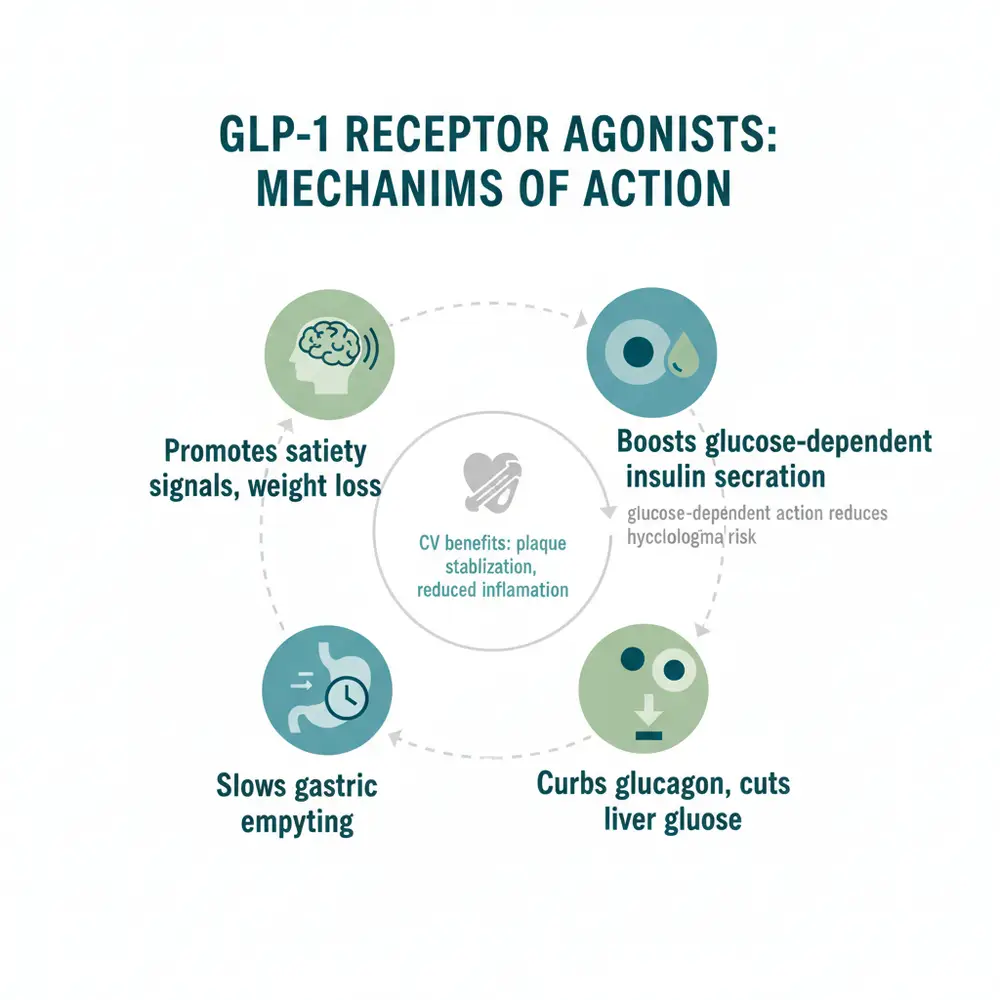
GLP-1 receptor Mechanisms of Action
GLP-1 receptor agonists boost insulin secretion from beta cells during hyperglycemia only. This glucose-dependent action reduces hypoglycemia risk. They also curb glucagon from alpha cells, cutting liver glucose output for better control.
Additionally, GLP-1 receptor agonists slow gastric emptying, blunting post-meal glucose spikes. This promotes brain satiety signals, curbing appetite and driving weight loss. These gut-brain-pancreas synergies address T2DM’s hyperglycemia and obesity aspects observed in studies.
Cardiovascular effects observed in trials arise via epicardial fat reduction, better endothelial function, less inflammation, and improved blood flow. GLP-1 receptor agonists stabilize plaques, reducing risks beyond glucose effects. Receptors across pancreas, gut, brain, and heart enable broad impacts on insulin sensitivity, energy use, and lipids.
### Therapeutic Applications
Glycemic control in T2DM defines GLP-1 receptor agonists’ core FDA-approved use. They lower HbA1c while aiding weight loss, studied in combination with diet, exercise, metformin, or sulfonylureas.
Higher doses of semaglutide and liraglutide earned FDA approval for obesity treatment, with or without T2DM. Their appetite suppression supports weight loss observed in trials.
For T2DM with cardiovascular disease or risks, GLP-1 receptor agonists reduced events in trials across risk levels. Preliminary evidence from studies suggests potential benefits in areas like CKD in T2DM and NAFLD via effects on liver fat and inflammation. Thus, GLP-1 receptor agonists are being studied for broader cardiometabolic and kidney applications.
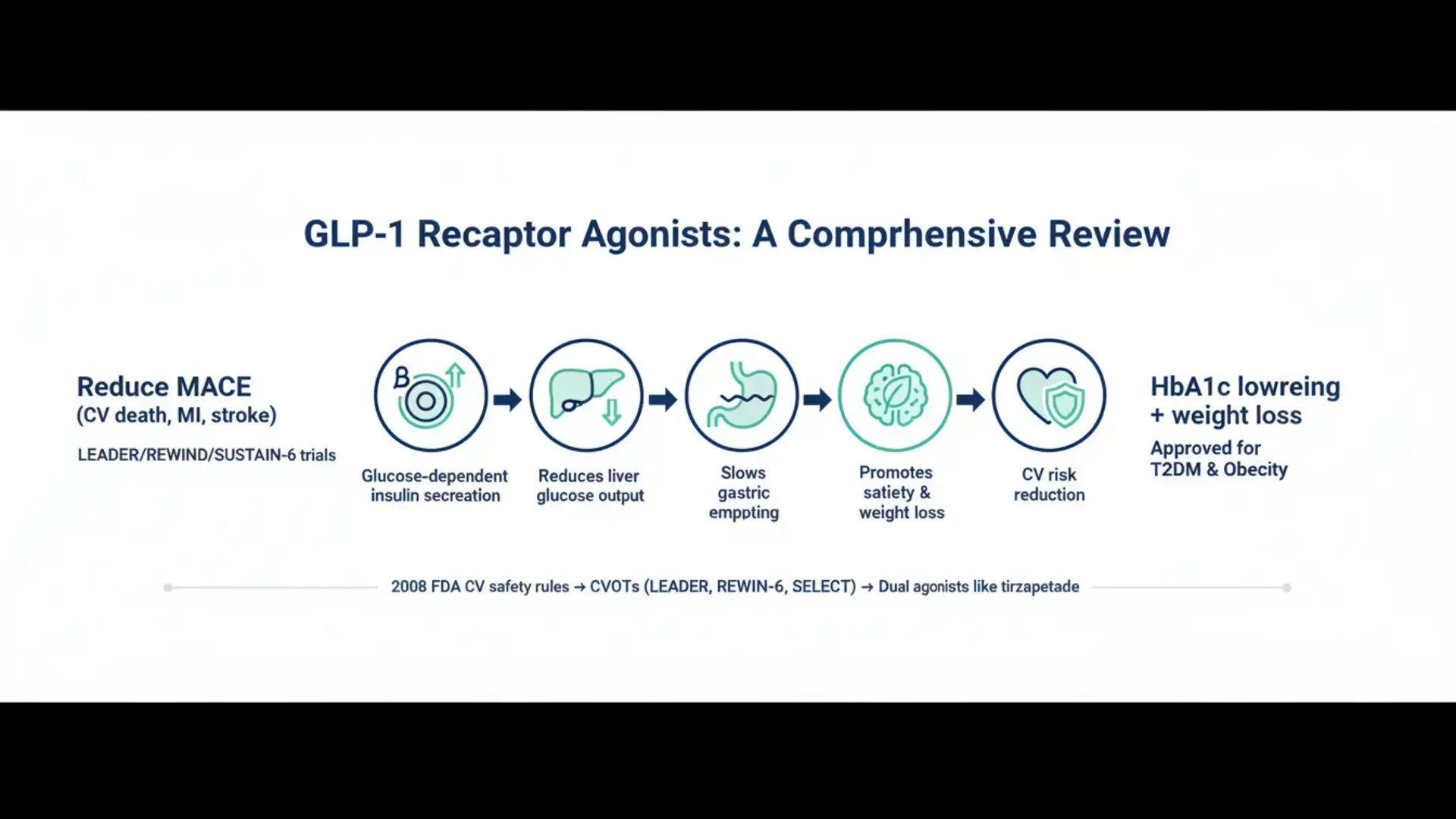
CVOTs solidify GLP-1 receptor agonists’ evidence. LEADER showed liraglutide reducing MACE—CV death, heart attacks, strokes. REWIND with dulaglutide reduced MACE in wider groups, including lower risk. SUSTAIN-6 confirmed semaglutide’s benefits in high-risk patients.
The SELECT trial extended to obese non-diabetics, demonstrating semaglutide’s vascular protection independent of glucose effects. Head-to-head studies show GLP-1 receptor agonists achieving HbA1c and weight loss outcomes compared to insulin, with long-term tolerability data.
Pooled data support benefits in T2DM with CV disease, CKD, or heart failure, aligning with clinical guidelines.
### Future Directions
SURPASS-CVOT tests tirzepatide’s CV safety, paving dual-agonist paths. Early research explores potential neuroprotective effects for brain disorders via anti-inflammatory mechanisms.
Long-term studies track rare risks and combos with SGLT2 inhibitors. Tailored use in elderly or CKD patients refines dosing and selection based on cardiorenal data.
### Challenges and Limitations
Gastrointestinal issues top GLP-1 receptor agonists’ hurdles—nausea, vomiting hit many during ramp-up, prompting dropouts. Slow titration helps tolerability.
Stopping GLP-1 receptor agonists risks weight regain as satiety fades. Some loss involves muscle, concerning for elders. High costs and access block equity, fueled by patents.
Immunogenicity, like exenatide antibodies, can weaken effects or cause reactions, though rarer now.
### Conclusion
GLP-1 receptor agonists are established in T2DM and obesity management, with clinical evidence for glycemic, weight, and CV outcomes across patient profiles—from CV disease patients to non-diabetic obese.
Trials like LEADER, REWIND, SUSTAIN-6, and SELECT confirm MACE reductions, HbA1c improvements, and weight loss versus rivals, supporting guidelines for high-risk use.
Yet, GI tolerability, regain risks, costs demand personalization via titration and support. Future dual agents, CKD/CNS research, and safety data may expand their roles.
### References
1. Mullur N. GLP-1 receptor agonist-based therapies and cardiovascular risk: a review of mechanisms. Journal of Endocrinology. 2024. https://joe.bioscientifica.com/view/journals/joe/263/1/JOE-24-0046.xml
2. Glucagon-Like Peptide-1 (GLP-1) Receptor Agonists: Exploring Their Impact on Diabetes, Obesity, and Cardiovascular Health Through a Comprehensive Literature Review. Cureus. 2024. https://www.cureus.com/articles/275769-glucagon-like-peptide-1-glp-1-receptor-agonists-exploring-their-impact-on-diabetes-obesity-and-cardiovascular-health-through-a-comprehensive-literature-review
3. Ma X, et al. GLP-1 RAs: CV Actions & Therapeutic Potential. PMC. 2021. https://pmc.ncbi.nlm.nih.gov/articles/PMC8193264/
4. The expanding role of GLP-1 receptor agonists: a narrative review of current evidence and future directions. ScienceDirect. 2025. https://www.sciencedirect.com/science/article/pii/S2589537025002950
5. GLP1RAs in Clinical Practice. American College of Cardiology. 2024. https://www.acc.org/Latest-in-Cardiology/Articles/2024/04/15/11/19/GLP1RAs-in-Clinical-Practice
6. Semaglutide and Cardiovascular Outcomes in Obesity without Diabetes. New England Journal of Medicine. 2023. https://www.nejm.org/doi/full/10.1056/NEJMoa2307563
7. Marx N, et al. GLP-1 Agonists for Cardiovascular Risk in Type 2 Diabetes. Circulation. 2022. https://www.ahajournals.org/doi/10.1161/CIRCULATIONAHA.122.059595
8. KDIGO 2022 Clinical Practice Guideline for Diabetes Management in Chronic Kidney Disease. Kidney International. 2022. https://www.kidney-international.org/article/S0085-2538%2822%2900507-5/fulltext
9. Management of Type 2 Diabetes: Selecting Amongst Available Pharmacological Agents. NCBI Bookshelf. https://www.ncbi.nlm.nih.gov/books/NBK425702/
10. Drug Therapies for Diabetes. PMC. 2023. https://pmc.ncbi.nlm.nih.gov/articles/PMC10742594/
References
### References
1. Mullur N. GLP-1 receptor agonist-based therapies and cardiovascular risk: a review of mechanisms. Journal of Endocrinology. 2024. https://joe.bioscientifica.com/view/journals/joe/263/1/JOE-24-0046.xml
2. Glucagon-Like Peptide-1 (GLP-1) Receptor Agonists: Exploring Their Impact on Diabetes, Obesity, and Cardiovascular Health Through a Comprehensive Literature Review. Cureus. 2024. https://www.cureus.com/articles/275769-glucagon-like-peptide-1-glp-1-receptor-agonists-exploring-their-impact-on-diabetes-obesity-and-cardiovascular-health-through-a-comprehensive-literature-review
3. Ma X, et al. GLP-1 RAs: CV Actions & Therapeutic Potential. PMC. 2021. https://pmc.ncbi.nlm.nih.gov/articles/PMC8193264/
4. The expanding role of GLP-1 receptor agonists: a narrative review of current evidence and future directions. ScienceDirect. 2025. https://www.sciencedirect.com/science/article/pii/S2589537025002950
5. GLP1RAs in Clinical Practice. American College of Cardiology. 2024. https://www.acc.org/Latest-in-Cardiology/Articles/2024/04/15/11/19/GLP1RAs-in-Clinical-Practice
6. Semaglutide and Cardiovascular Outcomes in Obesity without Diabetes. New England Journal of Medicine. 2023. https://www.nejm.org/doi/full/10.1056/NEJMoa2307563
7. Marx N, et al. GLP-1 Agonists for Cardiovascular Risk in Type 2 Diabetes. Circulation. 2022. https://www.ahajournals.org/doi/10.1161/CIRCULATIONAHA.122.059595
8. KDIGO 2022 Clinical Practice Guideline for Diabetes Management in Chronic Kidney Disease. Kidney International. 2022. https://www.kidney-international.org/article/S0085-2538%2822%2900507-5/fulltext
9. Management of Type 2 Diabetes: Selecting Amongst Available Pharmacological Agents. NCBI Bookshelf. https://www.ncbi.nlm.nih.gov/books/NBK425702/
10. Drug Therapies for Diabetes. PMC. 2023. https://pmc.ncbi.nlm.nih.gov/articles/PMC10742594/