
For Research Use Only. Educational content for laboratory research literacy. Not medical advice; not for human use.
Documentation notes for lyophilized peptides
Research teams evaluating lyophilized peptides should confirm lot documentation, identity methods, and research-use-only labeling before ordering.
Research teams evaluating lyophilized peptides should confirm lot documentation, identity methods, and research-use-only labeling before ordering.
Research teams evaluating lyophilized peptides should confirm lot documentation, identity methods, and research-use-only labeling before ordering.
Research teams evaluating lyophilized peptides should confirm lot documentation, identity methods, and research-use-only labeling before ordering.
Primary literature is indexed on PubMed and federal resources at NIH.gov. Browse related materials in the Nationwide Peptides shop.

Lyophilized peptides storage priorities
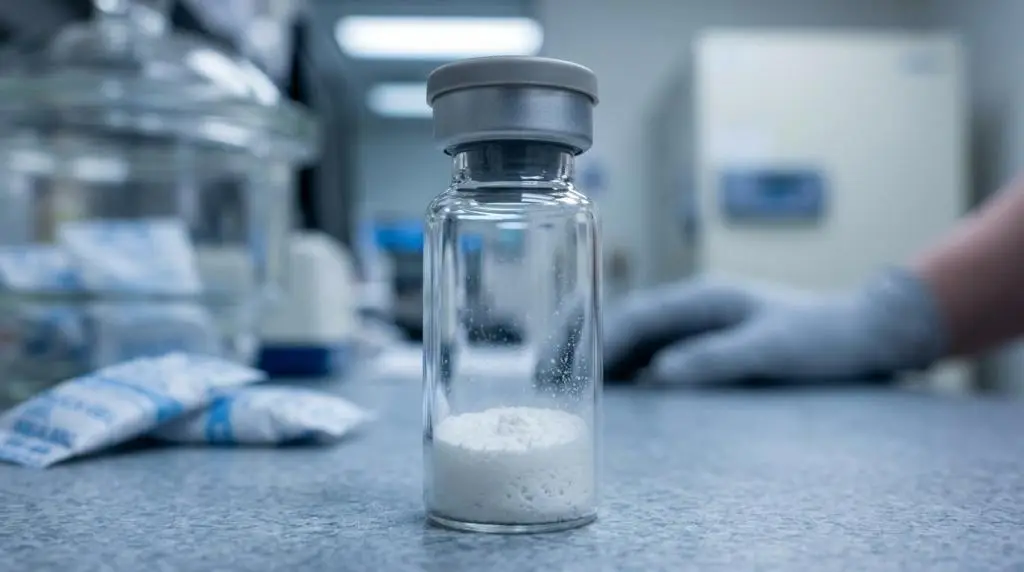
Lyophilized peptides are freeze-dried research materials. Labs handling lyophilized peptides usually focus on moisture control, cold-chain discipline, and avoiding unnecessary freeze-thaw cycles.
Review lyophilized peptides literature on PubMed and program context at NIH.gov, then compare catalog options in the research peptides shop.
Practical checks for lyophilized peptides
When receiving lyophilized peptides, document vial integrity, desiccant presence if supplied, labeled storage range, and COA lot match before inventory. Those notes keep lyophilized peptides handling consistent across study phases.
Quick Answer
Quick research overview
Lyophilized peptides are freeze-dried research materials. In day-to-day laboratory workflows, lyophilized peptides often tolerate storage better than equivalent solutions when moisture and temperature are controlled. Understanding lyophilized peptides helps research teams plan vial handling, reconstitution timing, and inventory rotation.
How Lyophilized Peptides Affect Storage and Stability
Scientific Snapshot
| Research Topic | How Lyophilized Peptides Affect Storage and Stability |
| Content Type | Laboratory research education guide |
| Scientific Focus | Documentation, handling, and research literacy |
| Audience | Qualified research laboratories |
| Compliance Framing | Research use only / not for human use |
Quick Facts
| Article Format | Research guide |
| Primary Theme | How Lyophilized Peptides Affect Storage and Stability |
| Documentation Focus | COA / labeling / laboratory workflow literacy |
| Related Resources | PubMed, NIH, COA hub |
| Supplier Context | Nationwide Peptides research materials |
Key Takeaways
- Warm before opening : Bring the sealed vial to room temperature in a desiccator to reduce condensation risk.
- Keep the seal intact : Limit the time the vial spends open to ambient air.
- Control humidity : Dry storage conditions help preserve the benefit created by lyophilization.
- Watch residual water : Small amounts of retained moisture can still affect stability over time.
Table of Contents
- Lyophilized peptides and research storage
- What lyophilization changes in peptide storage
- Why moisture control matters for lyophilized peptide stability
- Lyophilized peptide storage versus solution storage
- How temperature affects lyophilized peptide stability
- Why freeze-thaw cycles increase peptide variability
- What FDA guidance suggests about lyophilized peptide quality
- Practical storage priorities for lyophilized peptides in research labs
Lyophilized peptides and research storage
Lyophilized peptides are freeze-dried research materials. In day-to-day laboratory workflows, lyophilized peptides often tolerate storage better than equivalent solutions when moisture and temperature are controlled. Understanding lyophilized peptides helps research teams plan vial handling, reconstitution timing, and inventory rotation.
This article reviews why lyophilized peptides are widely used for longer holds, how residual water undermines lyophilized peptides, and which practical habits protect lyophilized peptides after receipt. For literature context, see PubMed and NIH.gov. Related compounds are listed in the research peptides catalog.
Practical checklist for lyophilized peptides
In short, lyophilized peptides give labs a practical way to extend usable hold times, provided lyophilized peptides remain dry, labeled, and reconstituted only when the assay requires them.
When receiving lyophilized peptides, log lot numbers, keep vials sealed until use, limit warm-up cycles, and document reconstitution solvents. Those steps reduce variability across experiments that rely on lyophilized peptides from the same lot.
Practical checklist for lyophilized peptides
When receiving lyophilized peptides, log lot numbers, keep vials sealed until use, limit warm-up cycles, and document reconstitution solvents. Those steps reduce variability across experiments that rely on lyophilized peptides from the same lot.
Peptide stability is often treated as a chemistry question, but in routine research it is just as much a storage question. The same sequence can perform very differently depending on whether it remains in a dry lyophilized form or sits in solution storage, how much moisture reaches the vial, and how often it is warmed and cooled.
Lyophilization shifts that storage picture in a favorable direction by removing water from the formulation. That dry state reduces the conditions that support hydrolysis and other degradation pathways, which is why lyophilized peptides are generally preferred when a project requires longer holding times and more predictable handling.
What lyophilization changes in peptide storage
The U.S. Food and Drug Administration describes lyophilization as a drying process that removes water and solvent through sublimation and desorption, with the goal of limiting biological and chemical reactions at the selected storage temperature. In simple terms, less water usually means fewer opportunities for instability to develop during storage. The FDA’s inspection guidance also makes clear that drying quality matters, because poor process control can lead to potency, sterility, and stability problems. That means storage performance begins long before a vial reaches a freezer. FDA guidance on lyophilization
Residual moisture is the detail that often decides whether a dry peptide behaves like a stable material or a fragile one. A lyophilized cake may look intact and still carry enough residual water to shorten shelf life, especially if it is later exposed to humid air, light, or temperature changes.
That dry state is the reason storage planning should start at the unopened vial, not at reconstitution.
Why moisture control matters for lyophilized peptide stability
Published data support the value of moisture protection very clearly. In a 2017 study indexed on PubMed, lyophilized CSP7 formulations remained stable for up to 10 months at 5 °C when protected from moisture. The same work also examined chemical stability under different storage temperatures, agitation, and freeze-thaw handling. The message is straightforward: lyophilization helps, but moisture exposure can still undo much of that benefit.
A separate 2016 study available through PMC adds a practical handling detail that is easy to miss. Before reconstituting peptides, the authors recommend allowing the lyophilized powder to reach room temperature in a desiccator. That step helps prevent water absorption by unused material when the vial is opened. In busy lab settings, that small precaution can be the difference between a clean dry handling event and a vial that immediately begins taking on atmospheric moisture.
Moisture control is not just about long-term storage. It affects day-one consistency, reconstitution behavior, and repeatability across aliquots from the same batch.
After that point, a few habits tend to make the biggest difference:
- Warm before opening: Bring the sealed vial to room temperature in a desiccator to reduce condensation risk.
- Keep the seal intact: Limit the time the vial spends open to ambient air.
- Control humidity: Dry storage conditions help preserve the benefit created by lyophilization.
- Watch residual water: Small amounts of retained moisture can still affect stability over time.
Lyophilized peptide storage versus solution storage
The most useful comparison is not dry powder versus liquid in abstract terms, but how each form behaves during a real project. Lyophilized material is usually better suited to extended storage because the major driver of many degradation pathways, water, has been greatly reduced. Once reconstituted, the peptide enters a much less forgiving environment. Even when stored cold, solution handling usually comes with a shorter working window and tighter controls around thawing, light, and timing.
That does not mean solution storage is poor practice. It means solution storage is best treated as a near-term working format, while the lyophilized vial remains the preferred reserve format.
| Storage factor | Lyophilized peptide | Reconstituted peptide solution | Why it matters |
|---|---|---|---|
| Water exposure | Minimal when sealed and dry | Constant | Many degradation pathways proceed more readily in liquid |
| Long-term stability | Generally stronger under cold, low-moisture conditions | Typically shorter | Dry form reduces chemical activity during storage |
| Freeze-thaw sensitivity | Lower before reconstitution | Higher after repeated cycling | Thaw events can introduce variability and instability |
| Handling risk | Humidity and condensation during opening | Timing, thaw count, and contamination risk | Each format has different control points |
| Light sensitivity | Still relevant | Still relevant, often more time-sensitive | Protection from light supports consistency |
The published literature behind this pattern is consistent with ordinary lab experience: dry, cold, protected storage supports stability better than keeping peptide material in solution for extended periods.
How temperature affects lyophilized peptide stability
Temperature still matters even after a peptide has been freeze-dried. The same PubMed study on CSP7 compared lyophilized cakes stored at 5 °C and 25 °C over four weeks as part of chemical stability testing, and the longer-term result was especially notable at the cooler condition when moisture was controlled. Lower temperatures reduce reaction rates, which gives the dry state more room to do its job.
A practical reading of those data is that lyophilization is not a substitute for cold storage. It works best in combination with cold storage.
The PMC study points in the same direction from a different angle. For most peptides examined, peak-area variability was lower under freezer storage than under other storage conditions, while variability was highest after ten freeze-thaw cycles. That does not mean every peptide responds identically, but it does support a conservative storage model: cold, consistent, and dry is generally better than cool one day, warm the next, and repeatedly thawed in between. PMC peptide storage study
When labs set storage priorities, the hierarchy is usually simple:
- Low temperature
- Stable temperature
- Dry environment
- Light protection
Why freeze-thaw cycles increase peptide variability
Freeze-thaw handling is one of the easiest ways to lose consistency without realizing it. Each thaw event can expose the peptide to temporary warming, local concentration changes, container surface effects, and extra time in solution. Over multiple cycles, those small stresses add up. The PMC study reported the highest variability after ten freeze-thaw cycles, which gives a clear experimental basis for minimizing repeated cycling.
The CSP7 work also evaluated freeze-thaw stress and agitation as part of chemical stability testing. That detail matters because instability is not caused by temperature alone. Movement, repeated handling, and the time spent outside ideal storage conditions can all contribute to unwanted change.
A few procedural choices can cut that risk sharply:
- Single-use portions: Prepare aliquots sized to the assay plan when the protocol allows.
- Minimize thaw events: Return material to controlled storage only when repeated warming can be avoided.
- Reduce handling stress: Limit unnecessary agitation during storage and preparation.
This is one of the clearest cases where operational discipline improves data quality without changing the peptide itself.
What FDA guidance suggests about lyophilized peptide quality
The FDA’s guidance is useful because it frames lyophilization as both a manufacturing process and a stability strategy. Water removal by sublimation and desorption is intended to suppress the reactions that continue in wetter systems, but the agency also warns that poor control can compromise quality. FDA inspection guide
That perspective is valuable in research procurement and storage planning. A well-dried peptide stored badly can degrade. A poorly dried peptide stored carefully may still present avoidable risk. Stability is rarely the result of one good decision. It is usually the result of several compatible decisions, starting with low residual moisture and continuing through cold storage, sealed containment, and limited handling.
Practical storage priorities for lyophilized peptides in research labs
For many labs, the strongest baseline approach is to keep peptides in the lyophilized state until a project actually requires reconstitution. That reduces time in solution and cuts down the number of variables that can affect repeatability. When a vial is needed, allowing it to warm to room temperature in a desiccator before opening helps prevent moisture uptake. Once reconstituted, careful aliquoting and a strict record of thaw events support cleaner workflows.
Light and humidity deserve attention alongside temperature. Even when the freezer setting is right, exposure during transport between storage and bench space can chip away at the gains created by lyophilization. A peptide that is dry, cold, sealed, and protected from light is operating under conditions that published studies consistently favor.
The practical takeaway for storage design is narrow but powerful: use lyophilization as the long-hold format, keep moisture out, keep temperature low and stable, and treat freeze-thaw cycles as a measurable source of variability rather than a minor inconvenience.
Explore Research Peptides
Review research peptide documentation standards, COA resources, and laboratory-focused product information from Nationwide Peptides.