
For Research Use Only. Educational content for laboratory research literacy. Not medical advice; not for human use.
GHK-Cu vs BPC-157 for laboratory teams
This section summarizes how GHK-Cu vs BPC-157 topics are handled in documentation-first laboratory workflows. Teams evaluating GHK-Cu vs BPC-157 should prioritize certificates of analysis, research-use labeling, and lot traceability before procurement decisions.
For primary literature on GHK-Cu vs BPC-157, start with PubMed and program context at NIH.gov. Review related materials in the research peptides catalog.
Documentation checks related to GHK-Cu vs BPC-157
When GHK-Cu vs BPC-157 appears in a protocol plan, keep identity testing method, purity report, storage guidance, and supplier transparency notes with the project file. Clear records make GHK-Cu / BPC-157 comparisons across lots more reliable for research continuity.
This guide focuses on GHK-Cu / BPC-157 for laboratory documentation and research planning.
What Is the Difference in a GHK-Cu vs BPC-157 Comparison?
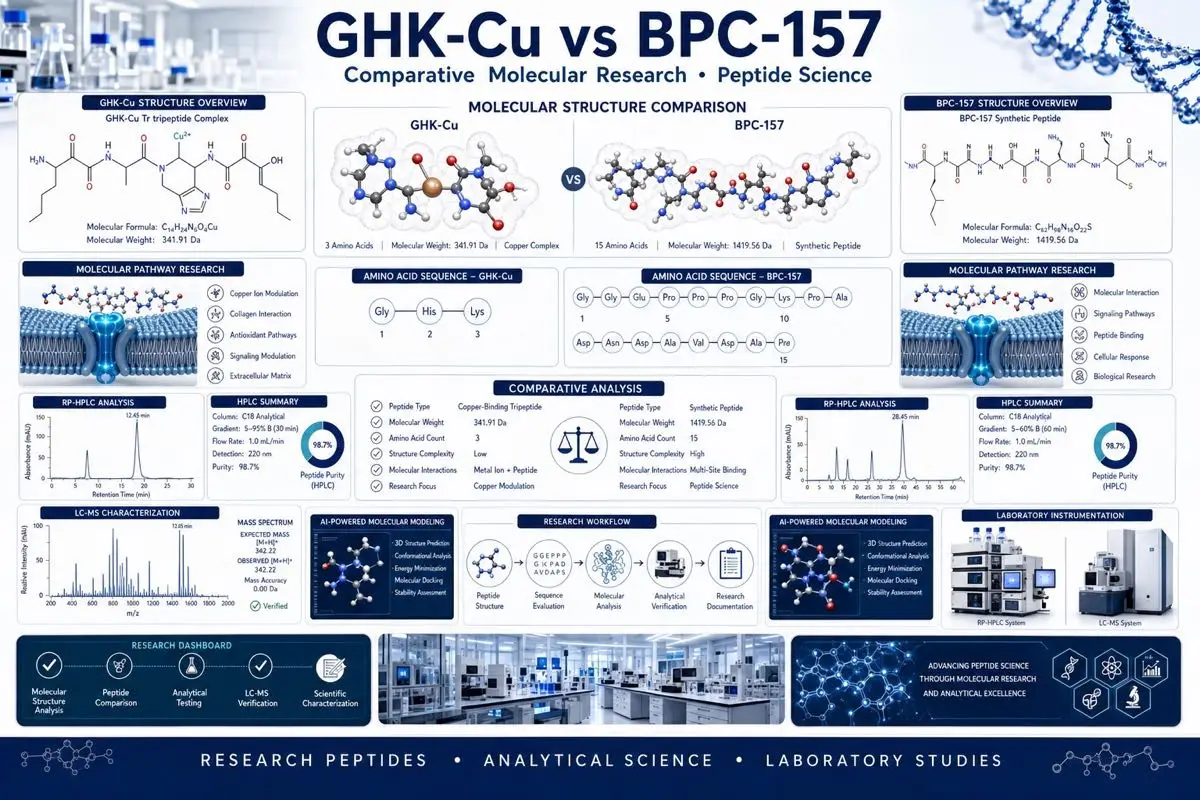
GHK-Cu and BPC-157 are fundamentally different research peptides despite often being discussed together in laboratory literature on tissue biology. GHK-Cu (Glycyl-L-histidyl-L-lysine copper) is a naturally occurring copper-binding tripeptide identified in human plasma, saliva, and urine and investigated for extracellular matrix biology, cellular signaling, and copper homeostasis. BPC-157 is a synthetic pentadecapeptide derived from a protective gastric protein sequence and is primarily investigated in preclinical models exploring angiogenesis, nitric oxide signaling, and tissue biology.
A careful GHK-Cu / BPC-157 review should keep biological origin, molecular architecture, analytical methods, and study models explicit. Overlapping research themes do not make the compounds interchangeable.
GHK-Cu vs BPC-157: Scientific Comparison, Molecular Differences & Laboratory Research Guide
| Characteristic | GHK-Cu | BPC-157 |
|---|---|---|
| Scientific Classification | Endogenous copper-binding tripeptide | Synthetic pentadecapeptide |
| Biological Origin | Naturally occurring in human plasma and tissues | Derived from a gastric protein sequence |
| Primary Research Focus | Extracellular matrix biology and copper signaling | Angiogenesis and tissue biology research |
| Analytical Verification | RP-HPLC, LC-MS, amino acid analysis | RP-HPLC, LC-MS, peptide sequencing |
| Research Status | Preclinical and mechanistic laboratory research | Predominantly preclinical laboratory research |
| Comparison Topic | GHK-Cu vs BPC-157 scientific comparison |
| Research Category | Research peptides and laboratory investigation |
| Key Difference | Natural copper-binding peptide versus synthetic gastric-derived peptide |
| Laboratory Techniques | RP-HPLC, LC-MS, peptide sequencing, amino acid analysis |
| Evidence Base | Primarily experimental and preclinical studies |
| Purpose of This Guide | Educational scientific comparison for laboratory researchers |
Key Takeaways
- GHK-Cu is a naturally occurring copper-binding tripeptide, while BPC-157 is a synthetic pentadecapeptide derived from a gastric protein sequence.
- In GHK-Cu vs BPC-157 literature, overlapping tissue-biology themes should not be read as identical mechanisms.
- Researchers commonly verify both peptides with RP-HPLC and LC-MS before experimental use.
- Most published evidence for both molecules comes from laboratory and preclinical investigations.
- Biological origin, analytical quality, and evidence limits are essential when reading GHK-Cu vs BPC-157 claims.
Table of Contents
- Introduction
- Evidence Boundaries
- Scientific Foundations
- How Do the Molecular Structures Compare?
- Comparative Biology
- How Has Research Evolved?
- Why Is GHK-Cu vs BPC-157 Frequently Compared?
- Analytical Characterization
- Research Quality & COA
- Current Scientific Evidence
- Key Scientific Differences
- Frequently Asked Questions
- Scientific Resources & References
Introduction
Comparisons between GHK-Cu and BPC-157 are increasingly common in scientific discussions because both molecules appear in experimental models involving tissue biology, extracellular matrix remodeling, and cellular communication. A precise GHK-Cu / BPC-157 framing still begins with origin: one compound is an endogenous copper complex, the other a synthetic gastric-sequence fragment.
GHK-Cu is a naturally occurring copper-binding tripeptide first identified in human plasma and later detected in several biological tissues. Research has explored its involvement in extracellular matrix regulation, collagen-related biology, gene expression patterns, and copper-dependent cellular processes. In contrast, BPC-157 is a synthetic peptide derived from a protective gastric protein sequence and has primarily been investigated in preclinical models examining angiogenesis, nitric oxide signaling, and tissue biology.
This GHK-Cu / BPC-157 guide provides a research-focused comparison of molecular composition, biological origin, laboratory characterization, current evidence, and analytical quality standards. The discussion is limited to scientific literature and experimental research and should not be interpreted as guidance for therapeutic or human use.
Research Note
Evidence Boundaries
Current knowledge regarding GHK-Cu and BPC-157 is derived primarily from laboratory investigations, mechanistic studies, and preclinical research models. While both peptides have attracted scientific interest, differences in experimental design, model systems, and study objectives make direct comparisons challenging. Throughout this guide, established findings are distinguished from ongoing areas of investigation to keep a GHK-Cu / BPC-157 overview evidence-based.
Scientific Foundations of GHK-Cu vs BPC-157
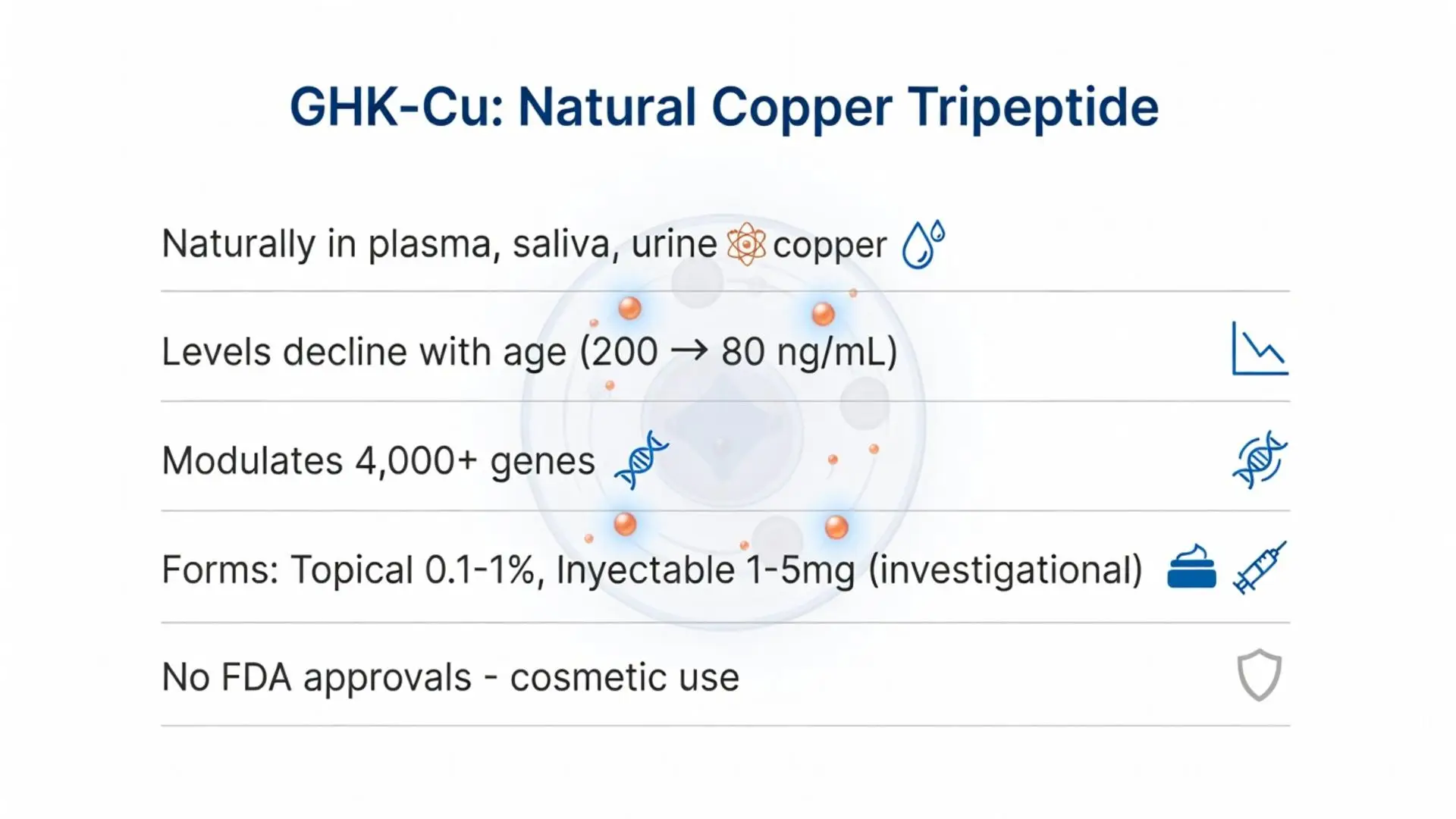
Before comparing experimental findings in GHK-Cu / BPC-157 studies, it is important to understand that the two peptides belong to different biochemical categories. GHK-Cu is typically discussed as a metal-coordinating tripeptide complex, whereas BPC-157 is discussed as a linear synthetic peptide fragment without that copper-binding identity.
GHK itself is a tripeptide (glycyl-L-histidyl-L-lysine). When complexed with copper(II), the resulting GHK-Cu species is investigated for interactions relevant to matrix biology and cellular signaling. Laboratory interest often centers on how copper coordination influences peptide behavior in vitro and how those observations map to extracellular-matrix and remodeling models.
BPC-157, abbreviated from Body Protection Compound-157, is a synthetic 15-amino-acid peptide. Scientific interest has focused primarily on cellular signaling themes, vascular biology models, and tissue-response readouts in preclinical systems. Those endpoints are not automatically transferable to GHK-Cu experimental designs.
Foundational literacy for GHK-Cu / BPC-157 therefore means reading each compound through its own chemistry first, then comparing only where study designs actually overlap.
How Do the Molecular Structures of GHK-Cu and BPC-157 Compare?
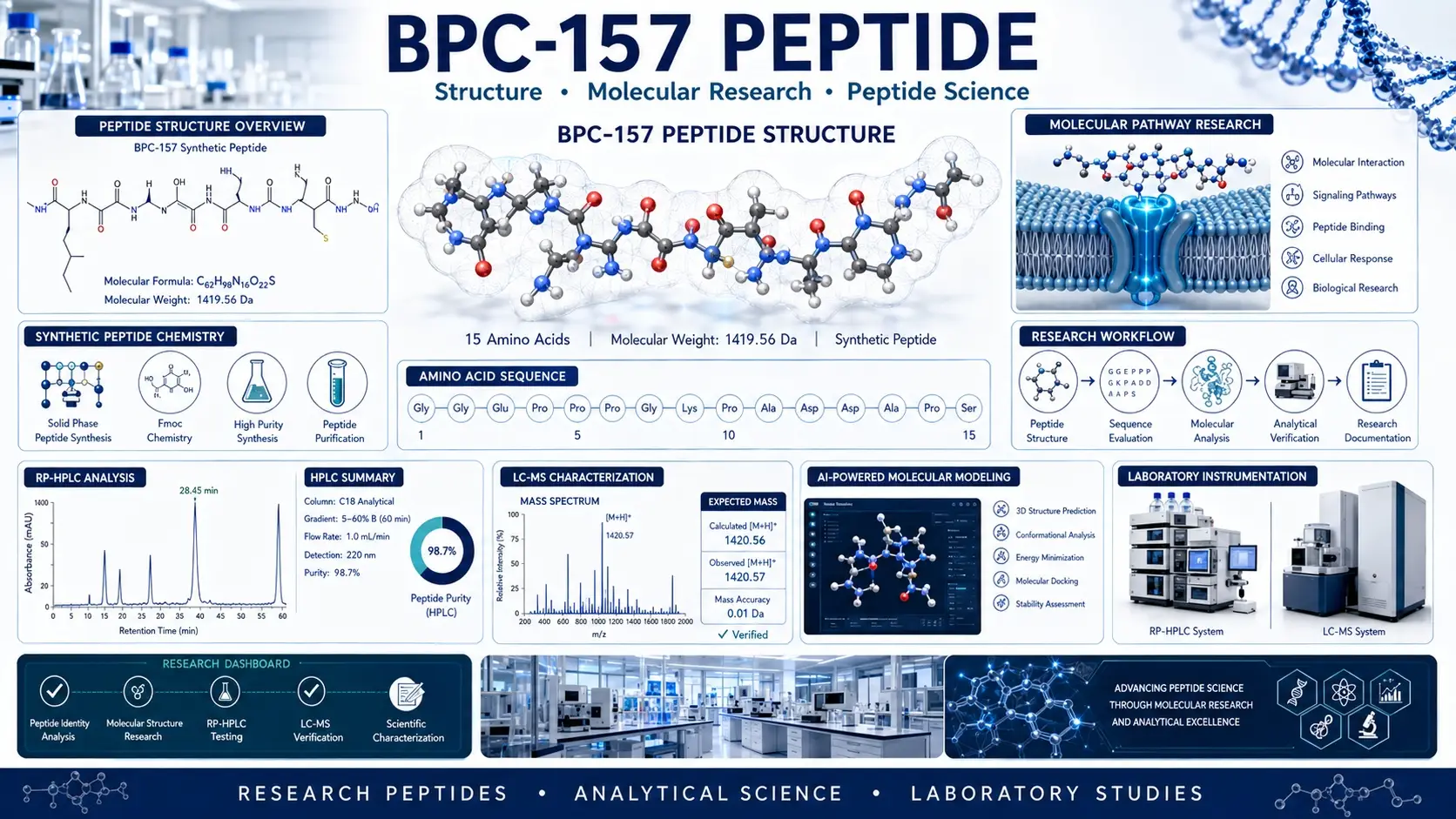
GHK-Cu / BPC-157 structure discussions usually start with chain length, metal coordination, and parent-sequence relationship. GHK-Cu is built around a three-residue peptide that coordinates copper, producing a compact complex with distinctive coordination chemistry. BPC-157 is a longer synthetic pentadecapeptide without that defining copper-complex identity.
Those structural differences shape handling notes, solubility discussions, and analytical expectations. Copper-peptide complexes can require documentation of metal stoichiometry and complex integrity, while synthetic linear peptides more often emphasize sequence confirmation, purity estimates, and impurity profiles.
Molecular structure is one of the most significant distinctions in any GHK-Cu / BPC-157 review. Clear structural notes keep claims grounded and prevent category errors when papers use similar tissue-biology vocabulary.
How Do Biological Research Themes Compare?
Mechanism summaries in GHK-Cu / BPC-157 literature should stay tied to the specific assay systems used in each paper. GHK-Cu research frequently references extracellular matrix biology, collagen-related pathways, and copper-linked cellular processes. BPC-157 research frequently references angiogenesis-related signaling, nitric oxide pathway themes, and preclinical tissue-response models.
Shared words such as remodeling, signaling, or repair do not establish a shared molecular pathway. Comparative reading works best when each claim is mapped to peptide identity, model organism or cell system, dose or exposure context in the original study, and measured endpoint.
Laboratory notebooks benefit from the same discipline. When an assay measures matrix-gene expression under a copper-peptide condition, that result should not be copied into a synthetic pentadecapeptide protocol without an explicit experimental bridge. Conversely, angiogenesis-oriented readouts from synthetic peptide models should not be imported into copper-tripeptide work as if the chemistries were equivalent.
This is especially important for trainees and cross-functional teams. Procurement staff, analytical chemists, and biology leads may use the same product names while meaning different experimental jobs. Written definitions of identity, intended model, and success criteria reduce that ambiguity before materials are opened.
Researchers therefore use a GHK-Cu / BPC-157 lens not because the peptides are interchangeable, but because both appear in regenerative-biology conversations and require careful separation of mechanism claims.
How Has Scientific Research on GHK-Cu vs BPC-157 Evolved?
Historical publication patterns help explain why GHK-Cu / BPC-157 remains a recurring laboratory comparison theme. GHK and GHK-Cu literature developed around endogenous peptide biology and copper coordination themes over decades of biochemical and dermatologic research interest. BPC-157 literature developed later as a synthetic peptide program centered on preclinical gastrointestinal and tissue-biology models.
As online research communities began clustering regenerative peptides together, comparison pages proliferated faster than carefully matched head-to-head experiments. That history is useful context: many GHK-Cu / BPC-157 discussions are taxonomic and educational rather than direct experimental contrasts.
Modern laboratory practice increasingly emphasizes analytical transparency, documentation standards, and precise language about what has actually been measured. Those habits improve comparative literacy even when dedicated head-to-head studies remain limited.
Publication volume alone is a weak proxy for decision quality. A dense literature can still leave important gaps in dose-response characterization, replication across laboratories, or clarity about complex identity. Sparse literatures can still contain carefully controlled mechanistic findings. Ranking compounds by citation count therefore mixes popularity with evidence strength.
For educational comparison pages, the responsible approach is to show where each literature is mature, where it is exploratory, and where public summaries over-extend the underlying designs. That framing helps readers escalate to primary sources instead of treating secondary summaries as final.
Why Is GHK-Cu vs BPC-157 Frequently Compared?
Search interest alone does not make compounds interchangeable; a rigorous GHK-Cu / BPC-157 comparison keeps origins and endpoints separate. Both molecules appear in conversations about tissue biology, so readers often encounter them in the same educational lists or inventory discussions.
Comparison is useful when it clarifies category differences: endogenous copper tripeptide complex versus synthetic gastric-sequence pentadecapeptide. Comparison becomes misleading when it implies a single ranking of effectiveness outside matched experimental systems.
For research teams, the practical value of GHK-Cu / BPC-157 framing is procurement and protocol clarity—knowing which identity, analytical file, and model language belongs with which material.
How Are GHK-Cu and BPC-157 Analytically Characterized?

Analytical panels used in GHK-Cu vs BPC-157 work typically emphasize identity confirmation, purity estimates, and documentation traceability. Common methods include reverse-phase HPLC for purity profiling and LC-MS for mass confirmation. Amino acid analysis or sequencing-related methods may appear depending on the laboratory workflow and supplier documentation package.
For GHK-Cu, additional attention may be paid to copper complex identity and related characterization notes because metal coordination is part of the compound definition used in research discussions. For BPC-157, sequence identity and impurity profiling are central because the compound is defined as a synthetic peptide fragment.
Good comparative practice is to read analytical claims at the lot level. A strong GHK-Cu vs BPC-157 documentation habit treats each COA as material-specific evidence rather than a generic category certificate.
How Should Researchers Evaluate Peptide Quality?
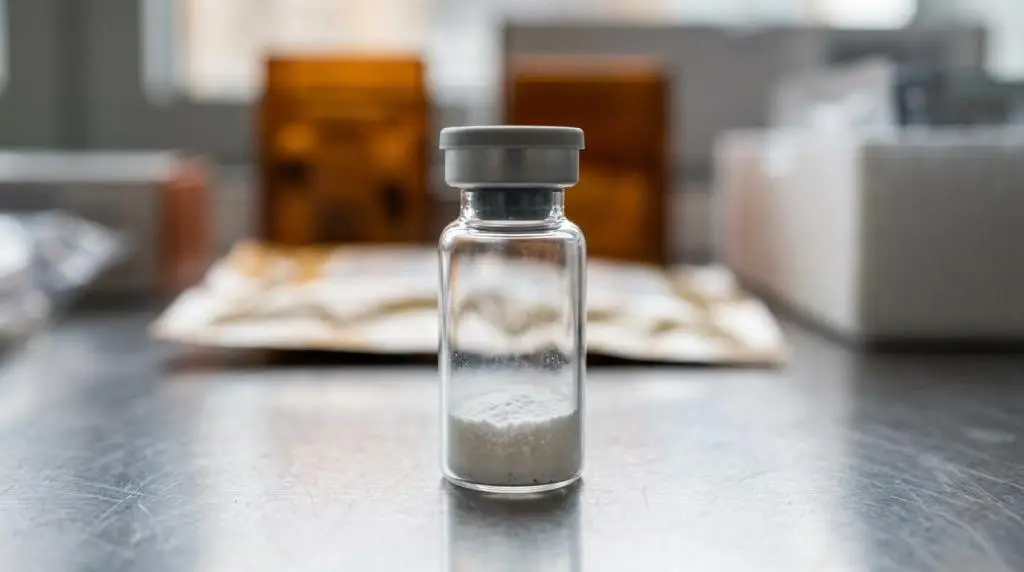
Quality checklists for GHK-Cu vs BPC-157 procurement should prioritize COA completeness, method clarity, and lot traceability. Teams typically confirm that reported methods match the claimed identity, that purity figures are accompanied by chromatograms or clear method notes where available, and that lot numbers on vials match accompanying files.
Storage and handling documentation also matter. Copper-peptide complexes and synthetic linear peptides can have different handling notes in supplier literature; transferring one material’s assumptions onto the other is a common source of lab friction.
Independent analytical testing, when used, should be interpreted with the same model discipline applied to biological papers: method, scope, and lot identity first.
Receiving workflows can encode these checks as a short gate: unlabeled vials hold, mismatched lot numbers hold, missing method descriptions hold, and incomplete seal records hold. Passing the gate does not prove biological performance; it only confirms that the laboratory is starting from coherent material identity.
Where copper-complex materials are involved, teams may also record whether documentation addresses complex-related characterization expectations used by that laboratory. Where synthetic linear peptides are involved, teams may emphasize sequence confirmation and impurity narrative quality. Parallel checklists prevent one material class from inheriting another class’s assumptions.
What Does Current Scientific Evidence Show About GHK-Cu vs BPC-157?
Evidence summaries for GHK-Cu vs BPC-157 should separate biochemical characterization from exploratory biological models. GHK-Cu has a substantial literature trail around endogenous peptide biology and copper-related cellular themes. BPC-157 has a substantial preclinical literature trail around synthetic peptide investigations in tissue and signaling models.
Direct, matched head-to-head experiments remain less common than parallel literatures. That means many comparison claims are inferential. Inferential comparison can still be educational when labeled honestly and when each citation is checked for model relevance.
A careful GHK-Cu vs BPC-157 reading still depends on matching claims to the underlying experimental model and endpoint. Strength of evidence should be described at the level of study design, not marketing adjacency.
GHK-Cu vs BPC-157: Key Scientific Differences at a Glance
| Dimension | GHK-Cu | BPC-157 |
|---|---|---|
| Origin | Endogenous copper-binding tripeptide complex | Synthetic gastric-sequence pentadecapeptide |
| Size / architecture | Tripeptide + copper coordination | 15-amino-acid linear peptide |
| Frequent research themes | Matrix biology, copper signaling, remodeling models | Angiogenesis, nitric oxide themes, tissue models |
| Analytical emphasis | Identity, purity, copper-complex documentation | Identity, purity, sequence/impurity documentation |
| Best comparative use | Clarify category and documentation needs | Clarify category and documentation needs |
The comparison between these materials is most valuable when it highlights category boundaries. Similar research themes do not imply identical biological mechanisms.
Lab Checklist
GHK-Cu vs BPC-157 Intake Checklist for Research Teams
When a GHK-Cu vs BPC-157 procurement cycle begins, confirm each lot number, seal integrity, and matching analytical file before materials enter shared inventory.
Keep GHK-Cu vs BPC-157 purchasing notes aligned with experimental classification language so documentation does not drift between procurement and bench teams.
Archive GHK-Cu vs BPC-157 related COAs with consistent filenames so retrieval stays reliable across projects.
Frequently Asked Questions
What is the primary scientific difference in GHK-Cu vs BPC-157?
The primary scientific difference lies in biological origin and molecular architecture. GHK-Cu is an endogenous copper-binding tripeptide complex investigated in matrix and copper-related research themes. BPC-157 is a synthetic pentadecapeptide derived from a gastric protein sequence and investigated mainly in preclinical tissue-biology models.
Research Takeaway: Similar research themes do not imply identical biological mechanisms.
Why is GHK-Cu vs BPC-157 frequently compared?
GHK-Cu vs BPC-157 comparisons are common because both appear in regenerative-biology education and laboratory inventory discussions. Comparison is most useful for clarifying categories, not for ranking compounds outside matched experiments.
Are GHK-Cu and BPC-157 interchangeable in laboratory models?
No. Interchangeability would require matched evidence that the same endpoints respond similarly under comparable conditions. Current literatures are largely parallel rather than directly substituted. Protocol design should follow the specific peptide identity under study.
What analytical methods are commonly referenced?
RP-HPLC and LC-MS are commonly referenced for identity and purity support in GHK-Cu vs BPC-157 documentation packages. Additional methods may be used depending on laboratory requirements and whether copper-complex characterization is relevant.
How should researchers read conflicting online summaries?
Return to primary papers and lot-level analytical files. Evaluate model system, endpoint, and methods before accepting comparative language. Educational pages should support literacy, not replace source verification.
Final Scientific Perspective on GHK-Cu vs BPC-157
A precise GHK-Cu vs BPC-157 write-up should map each claim to peptide identity, analytical method, and model system rather than treating the compounds as interchangeable. GHK-Cu remains defined by endogenous copper-tripeptide chemistry; BPC-157 remains defined by synthetic gastric-sequence peptide chemistry.
For laboratories, the highest-value outcome of comparative education is cleaner documentation: correct names, correct COAs, and correct experimental language for each material.
Teams that institutionalize those habits usually spend less time untangling mixed inventories later. They also produce cleaner audit trails when methods, lot files, and experimental aims need to be reconstructed months after an assay series ends.
Ultimately, comparative literacy is a research-operations skill as much as a chemistry skill. The goal is not to declare a winner between distinct molecular classes; the goal is to keep experimental claims, analytical records, and material identities aligned.
Next Step
Continue Exploring Peptide Research Beyond GHK-Cu vs BPC-157
After reviewing GHK-Cu vs BPC-157 category differences, compare certificate of analysis practices used alongside literature reviews of research peptides.
Scientific Resources & References
- Pickart L. The human tri-peptide GHK and tissue remodeling.
- Pickart L, et al. The human copper-binding peptide GHK-Cu and regenerative themes in experimental literature.
- Sikiric P, et al. Experimental investigations of the stable gastric pentadecapeptide BPC-157.
- Goldstein AL, Kleinman HK. Advances in related peptide biology contexts used for comparative literacy.
- International Council for Harmonisation (ICH). Q6B specifications guidance for biotechnological/biological products.
References are provided for educational navigation of primary literature and standards documents. Readers should verify citation details against the original sources.
Strengthen Documentation Literacy
Use certificate of analysis resources when reviewing research materials discussed in this guide.