
This BPC-157 Peptide Research Guide summarizes molecular pathways, analytical methods, and published research context for laboratory teams.
Quick Answer
What Does This BPC-157 Peptide Research Guide Cover?
The BPC-157 peptide is a synthetic research peptide derived from a partial sequence of Body Protection Compound (BPC), a peptide originally identified in gastric protein research. Researchers using this BPC-157 Peptide Research Guide investigate BPC-157 peptides to better understand peptide structure, molecular signaling pathways, stability characteristics, and synthetic peptide biology within controlled laboratory models.
BPC-157 Peptide Research Guide: Molecular Pathways & Scientific Evidence Explained
Scientific Snapshot
| Research Category | Synthetic Peptide Research |
| Peptide Family | Body Protection Compound-Derived Peptide Fragment |
| Scientific Focus | Molecular Signaling & Structure-Function Studies |
| Research Methods | Cellular Models, Analytical Chemistry, Molecular Studies |
| Analysis Technologies | LC-MS, RP-HPLC, Peptide Characterization |
Research Compound Snapshot
| Compound Name | BPC-157 Peptide |
| Research Classification | Synthetic Pentadecapeptide |
| Sequence Length | 15 Amino Acids |
| Research Material Format | Lyophilized Research Peptide |
| Analytical Evaluation | Purity & Identity Characterization |
Key Takeaways
-
✓BPC-157 peptide research focuses on molecular pathways, peptide stability, and synthetic peptide characterization.
-
✓Scientific discussions around BPC-157 peptide benefits refer to findings observed within experimental research models.
-
✓BPC-157 and TB-500 peptide comparisons examine different peptide structures, origins, and research pathways.
-
✓Analytical methods including RP-HPLC and LC-MS support peptide identity and purity research.
Table of Contents
→ Molecular Structure & Peptide Sequence
→ BPC-157 and TB-500 Peptide Comparison
BPC-157 Peptide Research Guide: Introduction
The BPC-157 peptide has become one of the most widely researched synthetic peptides due to scientific interest in its molecular structure, peptide stability characteristics, and biological signaling pathways observed in experimental models.
Researchers studying peptide BPC 157 examine areas including amino acid sequence relationships, molecular interactions, peptide chemistry, and laboratory characterization methods.
This research guide explores BPC-157 peptides, molecular mechanisms, BPC-157 and TB-500 peptide comparisons, analytical testing methods, and current scientific understanding from a research-focused perspective.
What Is BPC-157 Peptide?
The BPC-157 peptide is a synthetic pentadecapeptide composed of a 15-amino-acid sequence derived from research involving Body Protection Compound (BPC), a peptide fragment originally identified during gastric protein studies. Scientific interest in BPC-157 focuses on understanding peptide stability, molecular signaling mechanisms, and structure-function relationships.
Unlike many naturally occurring peptides that undergo rapid structural changes in biological environments, BPC-157 peptides have been investigated in laboratory settings because of their molecular characteristics and sequence stability observed during experimental research.
Modern studies involving peptide BPC 157 examine amino acid arrangement, synthetic peptide chemistry, molecular interactions, and analytical characterization rather than general outcome-based interpretations.
Research Insight
BPC-157 Is Studied as a Stable Synthetic Peptide Fragment
Researchers study synthetic peptide fragments such as BPC-157 to understand how specific amino acid sequences influence molecular stability, structural behavior, and peptide interaction pathways in experimental systems.
BPC-157 Peptide Research Guide: Structure and Amino Acid Sequence
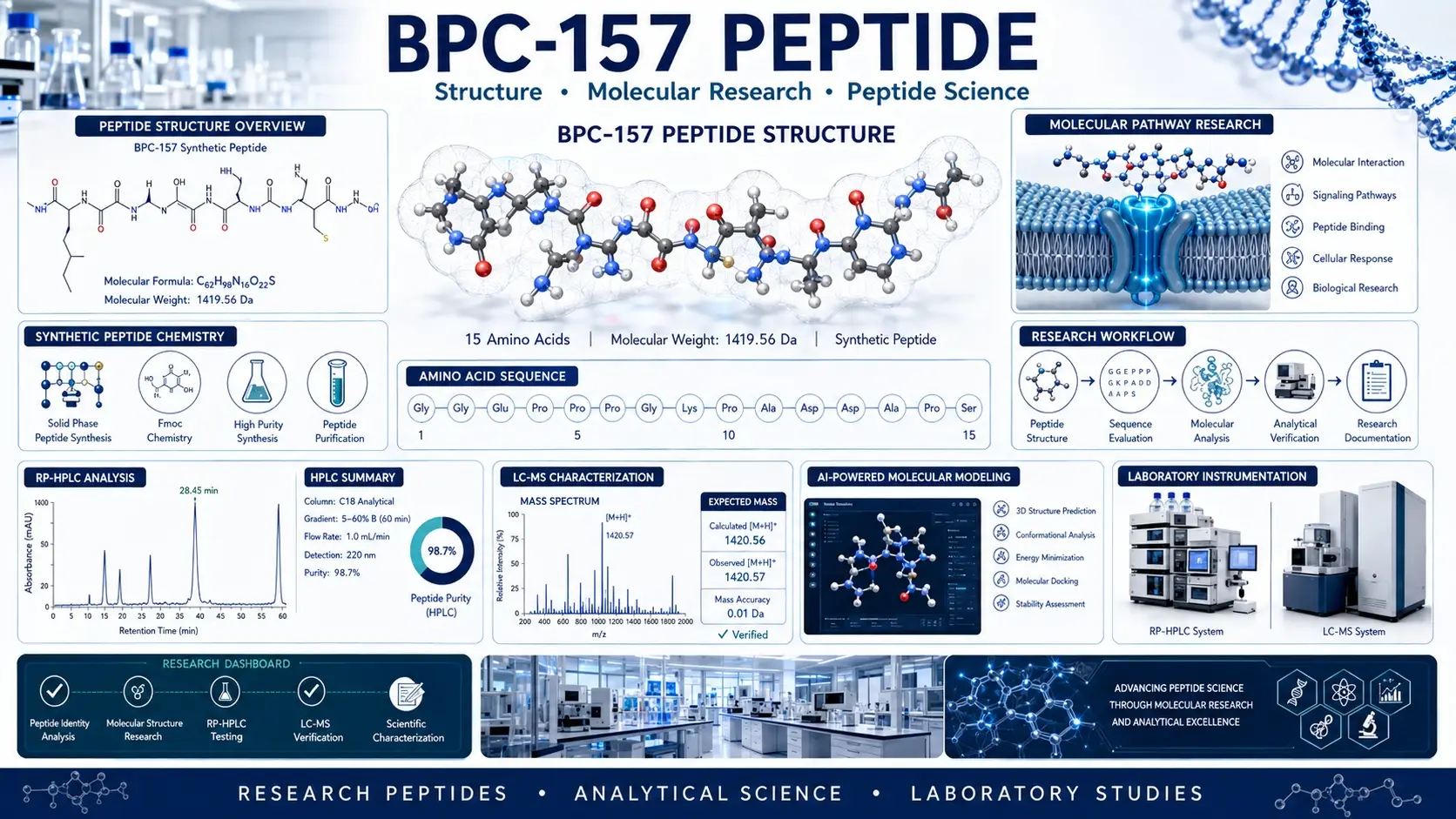
The molecular identity of BPC-157 peptide is defined by its specific amino acid arrangement. Sequence analysis is an important part of peptide research because even small structural variations can influence molecular properties and research observations.
Scientists analyze BPC-157 peptides through peptide chemistry methods to evaluate molecular composition, sequence integrity, and structural characteristics.
| Feature | BPC-157 Research Profile |
|---|---|
| Peptide Type | Synthetic Pentadecapeptide |
| Sequence Length | 15 Amino Acids |
| Research Origin | Body Protection Compound-Derived Fragment |
| Research Category | Synthetic Peptide Biology |
| Analytical Methods | LC-MS, RP-HPLC, Molecular Characterization |
Body Protection Compound (BPC) Research Background
BPC-157 originates from scientific investigations involving Body Protection Compound, a peptide sequence studied for its molecular properties and biological signaling pathways in research models.
Researchers continue examining this peptide category to understand how specific amino acid sequences may interact with complex molecular systems and contribute to broader peptide science knowledge.
Synthetic Peptide Classification of BPC-157
As a synthetic research peptide, BPC-157 is produced using controlled peptide synthesis methods that allow scientists to study defined molecular structures. Synthetic peptides are valuable research tools because their sequences can be characterized and analyzed with precision.
Research involving peptides BPC 157 commonly explores peptide chemistry, molecular stability, analytical testing, and comparison with other synthetic peptide categories.
BPC-157 and TB-500 Peptide Research Overview
BPC 157 and TB 500 peptide reflects growing scientific interest in comparing different peptide research categories. While both peptides are commonly discussed together, they represent distinct molecular structures and research areas.
Scientific comparisons between BPC-157 and TB-500 focus on peptide origin, amino acid structure, molecular pathways, and experimental research models rather than direct equivalency.
| Feature | BPC-157 Peptide | TB-500 Peptide |
|---|---|---|
| Research Category | Synthetic BPC Fragment | Thymosin Beta-4 Related Research |
| Primary Study Area | Peptide signaling research | Actin-binding peptide research |
| Scientific Focus | Structure-function relationships | Molecular pathway studies |
Did You Know?
Peptide Sequence Determines Molecular Research Characteristics
A peptide’s amino acid sequence influences its molecular properties. Researchers study sequence differences to better understand peptide stability, structure, and interaction patterns.
Section Summary
BPC-157 peptide research focuses on synthetic peptide chemistry, amino acid sequence analysis, molecular stability, and laboratory characterization. Scientific comparisons with peptides such as TB-500 help researchers understand differences between peptide families and molecular pathways.
BPC-157 Peptide Research Guide: Mechanisms and Scientific Studies
Scientific investigations involving the BPC-157 peptide focus on understanding molecular pathways, peptide signaling processes, and structure-function relationships. Researchers evaluate BPC-157 peptides through controlled laboratory models designed to study peptide behavior and biochemical interactions.
As a synthetic pentadecapeptide, BPC-157 provides researchers with a defined amino acid sequence for examining molecular stability, peptide communication pathways, and experimental peptide biology.
Discussions surrounding BPC-157 peptide benefits within scientific literature refer to research observations, molecular findings, and experimental outcomes rather than established practical applications.
Research Insight
BPC-157 Peptide Research Guide literature explores peptide signaling Networks
Peptide signaling research investigates how specific amino acid sequences interact with molecular systems. These studies help researchers understand relationships between peptide structure and biological pathways in experimental models.
Molecular Pathways Studied in BPC-157 Research
Research involving peptide BPC 157 has examined multiple molecular pathways to understand peptide interactions and signaling mechanisms. Scientists study these pathways through cellular research models, biochemical analysis, and molecular biology methods.
| Research Area | Scientific Focus | Research Objective |
|---|---|---|
| Peptide Signaling | Molecular communication pathways | Study peptide interactions |
| Cellular Models | Experimental pathway analysis | Understand molecular responses |
| Protein Interaction Research | Structure-function relationships | Evaluate peptide behavior |
| Molecular Stability | Sequence characteristics | Analyze peptide properties |
BPC-157 Peptide Research Guide: Research Context and Observed Outcomes
The phrase BPC-157 peptide benefits is commonly searched when reviewing scientific discussions around this peptide. In research contexts, this refers to observed molecular characteristics and experimental findings reported in laboratory studies.
Scientific interpretation requires evaluating study design, research models, peptide purity, analytical methods, and available evidence rather than assuming direct biological outcomes.
BPC-157 TB-500 Peptide Research Comparison
The search phrase BPC 157 TB 500 peptide reflects interest in comparing two widely studied synthetic peptide categories. Although frequently discussed together, BPC-157 and TB-500 differ in molecular origin, structure, and research focus.
Researchers compare peptides by analyzing amino acid composition, molecular pathways, structural characteristics, and experimental models.
| Scientific Feature | BPC-157 Peptide | TB-500 Peptide |
|---|---|---|
| Peptide Family | Body Protection Compound fragment research | Thymosin Beta-4 peptide research |
| Structure | 15-amino-acid peptide sequence | Synthetic peptide fragment |
| Research Interest | Peptide signaling pathways | Actin-related molecular studies |
| Analysis Methods | LC-MS / RP-HPLC | LC-MS / RP-HPLC |
Computational Research and BPC-157 Peptide Modeling
Modern peptide science increasingly uses computational modeling to investigate molecular structures and theoretical interactions. These technologies help researchers visualize peptide behavior and analyze possible structure-function relationships.
Computational approaches combined with analytical chemistry continue expanding scientific understanding of synthetic peptides BPC-157 and related peptide systems.
Did You Know?
Different Peptide Families Can Have Unique Molecular Characteristics
Peptides are classified based on sequence, origin, structure, and research characteristics. Comparing different peptide families helps scientists understand molecular diversity within peptide science.
Section Summary
BPC-157 peptide research focuses on molecular mechanisms, peptide signaling pathways, synthetic peptide biology, and structure-function studies. Scientific comparison with TB-500 highlights differences in peptide families, molecular characteristics, and research applications.
BPC-157 Peptide Research Guide: Synthesis and Molecular Characterization
Scientific research involving the BPC-157 peptide relies on precise peptide synthesis, purification processes, and analytical characterization methods. Because BPC-157 is a synthetic pentadecapeptide, researchers evaluate its molecular identity, amino acid sequence, purity profile, and structural characteristics through advanced laboratory techniques.
Modern peptide research commonly uses technologies such as solid-phase peptide synthesis (SPPS), reverse-phase high-performance liquid chromatography (RP-HPLC), liquid chromatography-mass spectrometry (LC-MS), and computational analysis to study synthetic peptide molecules.
Analytical verification plays an important role in research involving BPC 157 peptides, helping scientists examine molecular consistency and peptide characteristics before experimental investigation.
Solid-Phase Peptide Synthesis (SPPS) and BPC-157 Research
Solid-phase peptide synthesis is one of the most widely used approaches for producing synthetic research peptides. This process allows controlled assembly of amino acid sequences to create defined peptide structures for scientific analysis.
For peptide BPC 157 research, sequence accuracy and molecular characterization are important because peptide properties are directly connected to amino acid arrangement.
| Research Stage | Scientific Purpose | Evaluation Focus |
|---|---|---|
| Peptide Assembly | Creates target amino acid sequence | Sequence accuracy |
| Purification | Separates peptide components | Purity evaluation |
| Identity Testing | Confirms molecular characteristics | Analytical verification |
| Quality Analysis | Reviews peptide consistency | Research reliability |
Research Insight
BPC-157 Peptide Research Guide: Analytical Verification Practices
Peptide characterization technologies allow researchers to evaluate molecular identity, sequence consistency, and purity profiles before conducting advanced scientific studies.
BPC-157 Peptide Research Guide: RP-HPLC Purity Analysis
Reverse-phase high-performance liquid chromatography (RP-HPLC) is commonly used in peptide science to analyze purity profiles and separate molecular components. This technique helps researchers evaluate peptide composition and consistency.
For synthetic BPC-157 peptides, chromatographic analysis provides important information about molecular preparation and supports analytical research workflows.
BPC-157 Peptide Research Guide: LC-MS Verification and Identity Testing
Liquid chromatography-mass spectrometry (LC-MS) combines molecular separation with mass analysis. In work covered by this BPC-157 Peptide Research Guide, LC-MS allows scientists to examine molecular weight, peptide identity, and structural characteristics.
Mass spectrometry provides detailed molecular information that supports peptide chemistry research and scientific characterization.
| Testing Method | Research Information Provided |
|---|---|
| RP-HPLC | Purity profile and peptide separation analysis |
| LC-MS | Molecular weight and identity verification |
| Sequence Analysis | Amino acid structure confirmation |
| Computational Modeling | Molecular structure research |
BPC-157 Peptide Stability Research
Peptide stability research examines how molecular structures maintain their characteristics under controlled laboratory conditions. Scientists evaluate structural consistency, sequence integrity, and molecular behavior during analytical studies.
Understanding stability characteristics helps researchers maintain consistency when studying synthetic peptide compounds such as BPC-157.
Research Limitations and Scientific Interpretation
Scientific evaluation of BPC-157 requires careful review of study models, experimental conditions, analytical methods, and available peer-reviewed evidence.
Search topics such as BPC-157 peptide benefits should be interpreted through research findings and molecular studies rather than generalized conclusions.
Did You Know?
Modern Peptide Research Uses Multiple Analytical Technologies
Combining chromatography, mass spectrometry, and molecular modeling allows researchers to study synthetic peptides from several scientific perspectives.
Section Summary
BPC-157 peptide research relies on accurate synthesis, molecular characterization, RP-HPLC purity analysis, LC-MS verification, and stability evaluation. These analytical methods support scientific understanding of peptide identity and structure.
Research Compound Overview
BPC-157 Peptide Research Profile
BPC-157 peptide is studied as a synthetic research compound within peptide science. Research evaluation focuses on molecular identity, amino acid sequence analysis, purity characterization, and analytical testing standards.
| Research Compound | BPC-157 Peptide |
| Research Classification | Synthetic Pentadecapeptide |
| Peptide Length | 15 Amino Acids |
| Research Category | Synthetic Peptide Research |
| Material Format | Lyophilized Research Material |
| Analytical Methods | RP-HPLC Purity Analysis / LC-MS Identity Verification |
| Research Focus | Peptide Structure, Molecular Pathways & Laboratory Investigation |
Why Analytical Testing Matters in Peptide Research
Research peptides require detailed analytical evaluation to confirm molecular characteristics. Technologies such as RP-HPLC and LC-MS allow researchers to examine peptide purity profiles, molecular weight, and identity verification.
For compounds such as BPC-157 peptide, analytical documentation supports transparency and helps researchers evaluate peptide characteristics before laboratory investigation.
Research Specification Highlight
BPC-157 Research Documentation
Nationwide Peptides focuses on research-oriented peptide information, including compound specifications, analytical testing standards, and scientific documentation for laboratory research purposes.
Compliance Note
BPC-157 and related research peptides discussed by Nationwide Peptides are intended strictly for laboratory research purposes. Information provided is educational and should not be interpreted as medical, therapeutic, or usage guidance.
Current Scientific Understanding of BPC-157 Peptide Research
Current research involving the BPC-157 peptide focuses on understanding its molecular structure, peptide signaling characteristics, and interactions studied within experimental models. Scientific investigations continue exploring how this synthetic pentadecapeptide behaves at the molecular level.
Research discussions surrounding BPC 157 peptides involve multiple scientific disciplines, including peptide chemistry, molecular biology, analytical testing, computational modeling, and structure-function analysis.
As peptide research continues advancing, interpretation of scientific findings requires careful evaluation of experimental conditions, study models, analytical methods, and peer-reviewed evidence.
Research Insight
Peptide Research Is Becoming Increasingly Data Driven
Modern peptide science combines laboratory analysis, computational biology, and molecular modeling technologies to improve understanding of peptide structures and biological research pathways.
Future Directions in BPC-157 Peptide Research
Future research involving peptide BPC 157 is expected to continue exploring molecular mechanisms, peptide stability characteristics, structure analysis, and interactions within controlled experimental systems.
Advances in analytical technologies are allowing researchers to study synthetic peptides with greater precision, improving understanding of sequence relationships and molecular characteristics.
| Emerging Technology | Role in Peptide Research |
|---|---|
| Artificial Intelligence Modeling | Predicting peptide structures and molecular interactions |
| Machine Learning Analysis | Identifying peptide sequence patterns |
| Advanced Mass Spectrometry | Improving molecular characterization |
| Computational Biology | Modeling peptide behavior and structural relationships |
Artificial Intelligence and BPC-157 Molecular Modeling
Artificial intelligence tools are becoming increasingly important in peptide science. Researchers use computational systems to analyze amino acid sequences, predict molecular conformations, and investigate theoretical peptide interactions.
AI-assisted modeling does not replace laboratory analysis but provides additional tools that support peptide structure research and molecular investigation.
Scientific Comparison: BPC-157 and Related Research Peptides
Researchers often compare BPC-157 TB-500 peptide studies because both compounds represent important areas of synthetic peptide research. Scientific comparison helps identify differences in peptide families, structures, and molecular pathways.
These comparisons contribute to broader understanding of peptide diversity and the relationship between amino acid sequence and molecular characteristics.
Did You Know?
AI Systems Are Transforming Peptide Discovery Research
Machine learning and computational biology tools are helping researchers analyze peptide sequences, predict structures, and investigate molecular relationships with increasing accuracy.
Section Summary
BPC-157 peptide research continues evolving through advances in analytical chemistry, molecular modeling, artificial intelligence, and synthetic peptide science. Future research will continue improving scientific understanding of peptide structure, stability, and molecular interactions.
Frequently Asked Questions About BPC-157 Peptide
1. What is BPC-157 peptide?
The BPC-157 peptide is a synthetic pentadecapeptide consisting of 15 amino acids. It is studied in scientific research for its molecular structure, peptide stability, and interactions within experimental models.
2. What does BPC stand for in BPC-157?
BPC refers to Body Protection Compound, a peptide sequence originally identified during gastric protein research. BPC-157 represents a synthetic peptide fragment studied for molecular and biochemical characteristics.
3. What are BPC-157 peptides researched for?
Research involving BPC-157 peptides focuses on peptide signaling pathways, amino acid structure, molecular interactions, stability characteristics, and peptide chemistry.
4. What does BPC-157 peptide benefits mean in research?
The phrase BPC-157 peptide benefits commonly refers to observations reported within laboratory research studies. Scientific evaluation focuses on experimental findings, mechanisms, and molecular pathways rather than general outcomes.
5. What is the amino acid structure of peptide BPC 157?
Peptide BPC 157 is classified as a pentadecapeptide because it contains a chain of 15 amino acids. Researchers analyze this sequence to study structure-function relationships.
6. How are BPC-157 peptides analyzed?
Scientists analyze synthetic peptides BPC 157 using methods such as RP-HPLC purity testing, LC-MS molecular verification, and sequence characterization.
7. What is the difference between BPC-157 and TB-500 peptide research?
BPC-157 and TB-500 belong to different peptide research categories. BPC-157 originates from Body Protection Compound research, while TB-500 is associated with Thymosin Beta-4 peptide studies.
8. Why is LC-MS testing important for BPC-157 peptide research?
LC-MS testing helps researchers examine molecular identity, peptide mass, and structural characteristics during analytical peptide evaluation.
9. Why is RP-HPLC used in peptide research?
RP-HPLC is used to evaluate peptide purity profiles by separating molecular components and supporting analytical characterization.
10. How does AI support BPC-157 peptide research?
Artificial intelligence tools help researchers analyze peptide sequences, model molecular structures, and investigate theoretical peptide interactions.
11. Why compare BPC-157 TB-500 peptide research?
Comparing BPC-157 TB-500 peptide research helps scientists understand differences in peptide families, amino acid structures, and molecular pathways.
12. Are BPC-157 research peptides intended for scientific studies only?
Yes. Research peptides are intended for laboratory investigation and scientific study. Information about BPC-157 is provided for educational research purposes only.
Scientific Resources & References
The following peer-reviewed scientific resources explore BPC-157 research, peptide biology, molecular mechanisms, and analytical peptide science.
- Sikiric P, et al.
Stable gastric pentadecapeptide BPC 157 research overview.
View Research on PubMed
- Seiwerth S, Sikiric P, et al.
BPC-157 peptide experimental research studies.
View Research on PubMed
- Peptide Structure & Function Research
Scientific literature exploring peptide molecular relationships.
View Research on PubMed
- Solid Phase Peptide Synthesis Research
Research covering synthetic peptide chemistry methods.
View Research on PubMed
- LC-MS Peptide Characterization
Analytical chemistry methods for peptide identification.
View Research on PubMed
- RP-HPLC Peptide Purification Studies
Chromatography research for peptide purity analysis.
View Research on PubMed
- AI-Based Protein Structure Prediction
Jumper J, et al. Highly accurate protein structure prediction with AlphaFold.
View Research on PubMed
Final Takeaway
BPC-157 Peptide Research Continues Advancing Molecular Peptide Science
BPC-157 peptide research provides scientific insight into synthetic peptide chemistry, molecular pathways, analytical characterization, and structure-function relationships. Continued improvements in peptide synthesis, LC-MS verification, RP-HPLC analysis, and computational modeling are expanding understanding of synthetic research peptides.
Research Disclaimer
How to Use This BPC-157 Peptide Research Guide
This BPC-157 Peptide Research Guide is written for laboratory teams that need a structured overview of molecular pathways, analytical methods, and sourcing documentation norms. Keep the BPC-157 Peptide Research Guide alongside protocol notes so reviewers can cross-check citations without relying on marketing copy.
When updating experimental SOPs, treat the BPC-157 Peptide Research Guide as a map of questions rather than a set of conclusions. Each section of the BPC-157 Peptide Research Guide points back to PubMed-indexed literature and analytical checks that remain under active scientific evaluation.
Archive a dated copy of the BPC-157 Peptide Research Guide with each assay revision. Doing so keeps literature context, sequence notes, and verification methods in one place for auditability. Teams that revisit the BPC-157 Peptide Research Guide before ordering reagents usually catch labeling and COA gaps earlier.
Use the BPC-157 Peptide Research Guide checklist mindset: confirm RUO positioning, lot-matched COAs, and method descriptions before materials enter a live workflow. Re-reading the BPC-157 Peptide Research Guide after unexpected chromatograms also helps separate compound identity issues from method setup problems.
Readers can skim the BPC-157 Peptide Research Guide table of contents first, then deepen into synthesis, characterization, and pathway sections as needed. Bookmarking the BPC-157 Peptide Research Guide next to COA folders keeps scientific and procurement references aligned.
Laboratory Review Cadence for the BPC-157 Peptide Research Guide
Schedule a quarterly reread of the BPC-157 Peptide Research Guide whenever assay platforms change. A short agenda built from the BPC-157 Peptide Research Guide helps new staff learn sequence notes, RP-HPLC expectations, and literature boundaries in one sitting.
Pair the BPC-157 Peptide Research Guide with lot intake forms so COA fields mirror the analytical vocabulary used in the article. When results drift, return to the BPC-157 Peptide Research Guide sections on LC-MS and purity checks before altering protocols.
Printable excerpts from the BPC-157 Peptide Research Guide can sit next to instrumentation logs without implying clinical use. Keeping that boundary clear preserves the educational intent of the BPC-157 Peptide Research Guide while still supporting laboratory decision quality.
Finally, cite the BPC-157 Peptide Research Guide inside internal wikis with a date stamp. Versioned references make it easier to show which edition of the BPC-157 Peptide Research Guide informed a given method transfer.
Nationwide Peptides provides information strictly for educational and scientific research purposes. Research peptides discussed on this website are intended for laboratory research only and are not intended for human consumption, therapeutic use, diagnosis, treatment, or clinical application.