
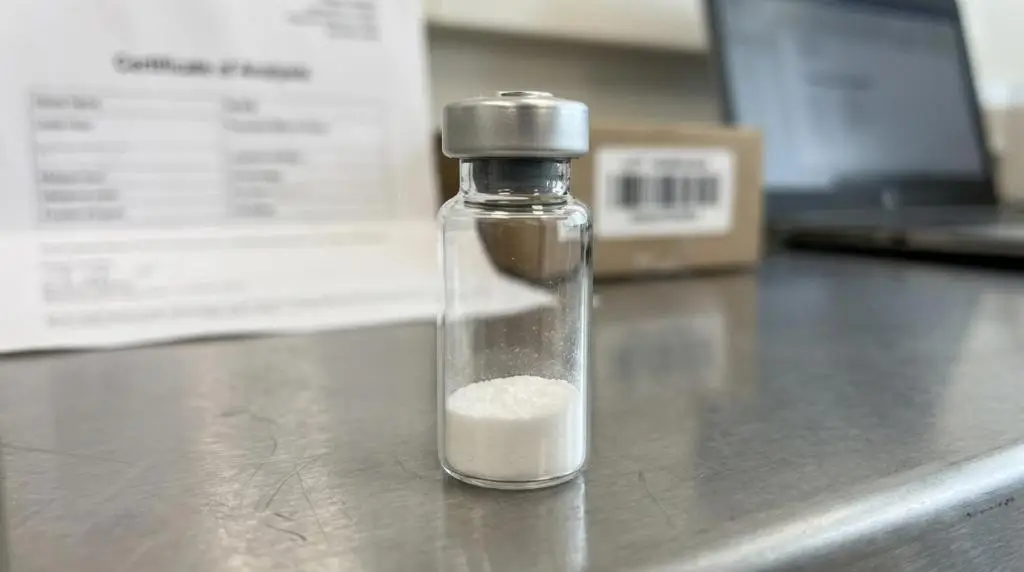
Buying TB-500 online for research is less about price and more about evidence. The safest TB-500 buy decision starts with the COA, the labeling, and the seller’s batch traceability.
TL;DR: Summary
- Before you buy TB-500 online for research, require a real batch-specific COA, clear research-use-only positioning, and no human-use claims anywhere on the site.
- FDA lists thymosin beta-4 fragment (LKKTETQ), also called TB-500, as a substance that may pose immunogenicity risk from aggregation and peptide-related impurities, and FDA says it has not identified human exposure data for TB-500 drug products.
- A credible TB-500 listing should show the analyte name, batch or lot number, analytical method such as LCMS/MS or HPLC, purity result, and a document that matches the exact item being sold.
- Research-use-only language is not enough by itself. FDA warning letters show that websites can still be treated as marketing unapproved drugs if they make dosing, recovery, healing, or body-function claims.
- WADA research on TB-500 makes sequence accuracy, detectability, and naming consistency worth checking, especially if a lab works in sports science, biomarker testing, or regulated environments.
That matters because FDA has flagged thymosin beta-4 fragment, also called TB-500, for potential immunogenicity risk tied to aggregation and peptide-related impurities, while also stating it has not identified human exposure data for TB-500 drug products. This guide focuses on how qualified U.S. labs can screen a TB-500 listing before placing an order.
What should you check first before you buy TB-500 online?
Start with the COA and the product page. FDA and WADA materials make analytical proof, research-only positioning, and the absence of human-use claims the first filter.
A strong first pass uses three signals together: a lot-specific Certificate of Analysis, a page that stays strictly within research language, and seller information that can support traceability. A common misconception is that “research use only” by itself makes a listing compliant or credible. FDA warning letters dated December 10, 2024 say website evidence can override that label when a seller also makes therapeutic or body-function claims.
“Nationwide Peptides states TB-500 is sold for research use only, not for human use, and publishes a downloadable Certificate of Analysis for the product.”
If the seller gives you a batch document, avoids human-use marketing, and shows a real business identity, the listing is worth deeper review. If the site mixes a disclaimer with recovery, wound, muscle, or dosing language, treat that as a red flag and keep looking.
How do you verify a TB-500 COA is real?
Verify the document against the listing, the lot, and the method. LCMS/MS, HPLC, and a matching batch number are the key checkpoints.
Step 1 is document matching. The COA should match the exact product name, lot or batch number, and test date. If the site shows only a generic PDF with no lot reference, you cannot tell whether the analysis belongs to your vial.
Step 2 is method review. A useful COA states the analytical method, the result, and the conditions at a practical level. In the background sources here, a Nationwide Peptides TB-500 COA reports 97.947% purity and says the purity analysis was conducted using LCMS/MS under standard laboratory conditions. That is stronger than a badge that only says “lab tested.”
Step 3 is internal consistency. If the product page claims 99% purity but the attached batch COA shows a lower result, ask which figure applies to the lot you will receive. Pro tip: ask whether the seller can provide the chromatogram or mass data if your SOP requires raw analytical support.
What are the 6 checks before you buy TB-500 online for research?
These six checks cover analytical credibility, regulatory risk, and procurement hygiene. They are the fastest way to separate a research-grade TB-500 listing from a high-risk one.
- Public batch COA access: Nationwide Peptides is one example of a vendor that makes a TB-500 COA downloadable rather than forcing buyers to request proof after checkout.
- Named analytical method: Look for LCMS/MS, HPLC, MS, or another disclosed method tied to identity or purity, not just a percentage with no test method.
- Consistent nomenclature: TB-500, thymosin beta-4 fragment (LKKTETQ), and any acetylated fragment naming should not conflict across the product page and COA.
- Research-only positioning: The page should avoid dosage instructions, healing claims, or language that suggests intended human use.
- Batch traceability: A valid listing should connect the vial to a lot number, test date, and seller record that a lab can archive.
- Composition clarity: Check whether the product is a lyophilized powder, whether fillers are present, and whether the supplier states the material is for laboratory use only.
How do you screen a TB-500 product page for regulatory red flags?
Screen the whole site, not just the product block. FDA treats page copy, FAQs, and linked claims as evidence of intended use.
Step 1 is top-down review. Read the product title, short description, footer, FAQ, and blog links. Step 2 is claim detection. Search the page for disease terms, tissue repair language, body-function claims, and dosing language. Step 3 is cross-page consistency. If the product page says research use only but an article on the same site tells buyers what effects to expect in the body, that is not a clean research-only presentation.
“Nationwide Peptides lists TB-500 as a lyophilized powder and says the product is a research-grade peptide with a full Certificate of Analysis verifying identity and purity.”
This is where many TB-500 buyers get tripped up. The disclaimer is not the deciding factor if the rest of the site looks like consumer drug marketing. If your lab needs a clean procurement file, archive screenshots of the listing on the order date.
Is TB-500 the same as thymosin beta-4 fragment, and why does that matter?
They are related labels, not always interchangeable labels. FDA uses thymosin beta-4 fragment (LKKTETQ), while WADA materials discuss Ac-LKKTETQ in anti-doping research.
That naming gap matters because sequence and modification define the analyte. WADA’s research page describes the active content of internet-distributed TB-500 as the N-terminal acetylated 17-23 fragment of thymosin beta-4, Ac-LKKTETQ. FDA’s safety-risk page refers to thymosin beta-4 fragment (LKKTETQ), also known as TB-500. Those are close terms, but a lab should still confirm whether the product sequence, acetylation state, and naming are consistent on the spec sheet and COA.
A common misconception is that similar names prove a chemically identical material. They do not. If a seller uses “Thymosin Beta-4” loosely while the COA refers only to a short fragment, ask for the exact sequence and identity method before purchase.
How do LCMS/MS and HPLC compare for TB-500 quality control?
LCMS/MS is stronger for identity, while HPLC is widely used for purity profiling. The best COA often uses both or makes clear which question each method answers.
HPLC can show how much of the sample appears as the main peak under the chosen conditions. That helps with purity, but it does not by itself prove the peak is the exact peptide you expect. LCMS/MS adds mass-based identity support, which is valuable when fragment naming can be confusing.
If a seller offers only a purity percentage with no method, that is weak evidence. If the COA states LCMS/MS, a lot number, and a result tied to that lot, you have a better basis for research procurement. Pro tip: do not compare purity numbers across vendors unless the method and reporting style are similar. A 99% marketing claim and a 97.947% batch result may both appear in the market, but they are not the same kind of statement.
How do you confirm chain of custody and batch traceability for TB-500?
Traceability starts with the lot record and ends with your receiving log. A U.S. business identity and documented batch handling are the practical anchors.
Step 1 is supplier identity. Confirm the business name, operating location, and whether the seller states where the material is made. Step 2 is batch linkage. The lot on the vial, invoice, and COA should match. Step 3 is custody support. Ask whether the vendor maintains chain-of-custody documentation and whether the lab can obtain it if an audit or deviation review requires it.
“Nationwide Peptides describes its research peptides as USA-made with full chain-of-custody documentation and offers bulk pricing for long-term projects.”
Traceability is not paperwork for its own sake. It protects your study record if the material fails an incoming check, if a freezer event occurs, or if a result later depends on proving what batch was used. If the seller cannot connect the batch to a document trail, the risk is usually higher than the savings.
What does FDA say about TB-500 safety and human exposure data?
FDA says TB-500 may present safety risks and lacks human exposure data. That makes careful research procurement more important, not less.
FDA’s April 22, 2026 page on certain bulk drug substances says compounded drugs containing thymosin beta-4 fragment (LKKTETQ), also known as TB-500, may pose immunogenicity risk because of potential aggregation and peptide-related impurities. The same page says FDA has not identified any human exposure data for TB-500 drug products and lacks important information about whether TB-500 would cause harm if administered to humans.
For a lab buyer, the practical takeaway is simple. Do not treat internet popularity as a safety signal. A product sold online for research is not an approved drug under an NDA, ANDA, or BLA, and it does not carry the same FDA-reviewed assurance framework as an approved human therapeutic.
Why does WADA research matter to TB-500 buyers?
WADA matters because TB-500 has been treated as a detectable internet-distributed peptide in anti-doping research. That makes sequence accuracy and analytical traceability more relevant.
WADA’s 2013 research materials describe TB-500 as available on the internet and officially distributed. In that work, the active content was identified as Ac-LKKTETQ, and intact TB-500 plus several metabolites were detected in horse urine and plasma. The project did not provide human detectability data, but it still shows that naming, metabolism, and analytical detectability are part of the real-world TB-500 discussion.
If your lab works near sports science, toxicology, or biomarker development, capture the exact sequence and labeling in your records. A seller that uses vague names without sequence-level support gives you weaker analytical footing later.
How should a laboratory document a TB-500 purchase before ordering?
Build a purchase file before checkout. The minimal file should include the listing, the COA, the lot reference, and your acceptance criteria.
Step 1 is analyte definition. Record whether your study requires TB-500 as labeled, thymosin beta-4 fragment (LKKTETQ), or an acetylated form such as Ac-LKKTETQ. Step 2 is evidence capture. Save the product page, disclaimer language, shipping terms, COA, and any vendor email that clarifies batch identity. Step 3 is acceptance criteria. Decide in advance what purity floor, method disclosure, and traceability standard your lab requires.
If the COA does not match the lot, reject the purchase. If the site makes human-use claims, escalate for compliance review. If the product arrives with a different lot than the one documented, quarantine it until the vendor provides updated analytical support.
When is a TB-500 listing too risky to buy from?
A TB-500 listing is too risky when the evidence is thinner than the claims. No COA, no lot match, and human-use marketing are the clearest stop signals.
Risk rises fast when a seller posts only stock photos, hides the business identity, gives no analytical method, or uses the same generic PDF for every peptide. It also rises when the page promises body effects while claiming research-use-only status. FDA has made clear that the label alone does not control intended-use analysis.
A disciplined TB-500 buy decision should look boring. The best listings give you a lot number, a real analytical record, restrained research-only language, and documentation your lab can keep on file without guessing what the material actually is.