Fall Special!
Use Code FALL2026 for 10% off Sitewide.
8 Facts About Bacteriostatic Water for Research Labs
For Research Use Only. Educational content for laboratory research literacy. Not medical advice; not for human use.
Bacteriostatic water for laboratory teams
This note clarifies how bacteriostatic water topics are handled in documentation-first workflows. Teams evaluating bacteriostatic water should prioritize certificates of analysis, research-use labeling, and lot traceability.
For primary literature on bacteriostatic water, review PubMed and program context at NIH.gov. Related materials are listed in the research peptides catalog.
Documentation checks for bacteriostatic water
When bacteriostatic water appears in a protocol plan, retain identity method, purity report, storage guidance, and supplier transparency notes. Clear files make bacteriostatic water lot comparisons more reliable over time.
bacteriostatic water
Quick Answer
Bacteriostatic water is sterile, nonpyrogenic water that typically contains 0.9% benzyl alcohol, and official labeling identifies it as a multiple-dose diluent for repeated withdrawals. The most important distinction is that bacteriostatic water is preserved, while sterile water for injection is preservative-free; they are not interchangeable in every labeled context. DailyMed and FDA materials warn that benzyl alcohol containing products are not appropriate for neonatal preparations, and preser
8 Facts About Bacteriostatic Water for Research Labs
Scientific Snapshot
Research Topic
8 Facts About Bacteriostatic Water for Research Labs
Content Type
Laboratory research education guide
Scientific Focus
Documentation, handling, and research literacy
Audience
Qualified research laboratories
Compliance Framing
Research use only / not for human use
Quick Facts
Article Format
Research guide
Primary Theme
8 Facts About Bacteriostatic Water for Research Labs
Documentation Focus
COA / labeling / laboratory workflow literacy
Related Resources
PubMed, NIH, COA hub
Supplier Context
Nationwide Peptides research materials
Key Takeaways
Label identity: bacteriostatic water, preservative content, vial size, and multiple-dose status are stated clearly
Handling instructions: storage range, light protection, and first-puncture discard rule are easy to verify
Quality documentation: lot traceability, chain of custody, and any available testing or vendor quality record are accessible
Workflow fit: the product is sold and documented for laboratory or research use only, not for human consumption
Bacteriostatic water is easy to misclassify because the name sounds generic, but official labeling is quite specific. For research labs, the main issues are composition, multi-dose handling, preservative warnings, and manufacturer-specific storage instructions.
In peptide research settings, that distinction matters because the support material may look simple while still carrying strict handling and labeling requirements. Any peptide, blend, or supply discussed in this context is for research use only and not intended for human use or human consumption.
How does bacteriostatic water compare with sterile water for injection?
Bacteriostatic water and sterile water for injection differ mainly in preservative content and use context. DailyMed and FDA labeling show bacteriostatic water contains benzyl alcohol, while sterile water for injection is the preservative-free option used when benzyl alcohol must be avoided.
The most practical difference is repeated access. Bacteriostatic water is labeled as a multiple-dose diluent because the preservative supports repeated withdrawals from the same vial under labeled conditions. Preservative-free sterile water does not carry that same rationale.
This is where labs sometimes overgeneralize. If a protocol, product insert, or compounding note specifies preservative-free sterile water, then bacteriostatic water is not the substitute. If the label specifically calls for bacteriostatic water to create a multiple-dose preparation, then the preserved product is the referenced material.
The FDA label for Ogivri provides a clean example of this distinction. It instructs reconstitution with bacteriostatic water containing benzyl alcohol to produce a multiple-dose solution, but directs use of preservative-free sterile water when benzyl alcohol hypersensitivity is a concern. That does not make one category “better” overall; it shows they serve different labeled purposes.
What are the 8 most important bacteriostatic water facts for research labs?
The most important facts are composition, label status, warning language, and discard timing. FDA and DailyMed materials give labs enough detail to build a controlled SOP without guessing.
After those basics are clear, eight facts stand out:
Bacteriostatic water is not just water. Official labels describe sterile, nonpyrogenic water with benzyl alcohol added as a bacteriostatic preservative.
A common labeled concentration is 0.9%. DailyMed and FDA recall materials identify 0.9% benzyl alcohol, equivalent to 9 mg/mL.
It is generally a multiple-dose product. Labels commonly state the vial is intended for repeated withdrawals.
It is a diluent category. Official labeling describes use for dissolving or diluting drugs for injection, not as a generic substitute for every sterile water application.
Neonatal warnings are explicit. FDA and DailyMed materials warn against benzyl alcohol containing preparations for neonates, with preservative-free sterile water identified instead.
Storage rules are label specific. Some products instruct storage at 20°C to 25°C, protection from light, and refrigeration after opening.
Discard timing starts at first puncture. Some labels require disposal 30 days after first puncture, while others may use 28 days.
Sterility assurance is still a procurement issue. FDA recall history shows that even basic support materials can have sterilization-related quality events, so lot verification matters.
A practical takeaway is that “bacteriostatic water” is a category name, not a full SOP. Researchers should work from the exact vial label and source documentation in hand.
How should a lab verify a bacteriostatic water vial on receipt?
A research lab should verify the label, lot, and storage instructions before the vial enters inventory. DailyMed and FDA materials make clear that concentration, preservative status, and discard rules are not details to fill in later.
Step 1 is identity confirmation. Match the product name, vial size, lot number, and stated preservative content against the vendor record and receiving log. If the label does not clearly state bacteriostatic water and benzyl alcohol content, hold the vial for review.
Step 2 is label review. Check whether the product is described as multiple-dose, whether light protection is required, and what the stated storage range is. A common mistake is recording only the expiration date while missing the first-puncture discard rule.
Step 3 is release decision. If the label is legible, the container is intact, and the storage conditions were maintained during transit, the vial can move into controlled stock according to site SOP. If any of those conditions fail, quarantine is the safer path.
This is also the stage where procurement records help. Vendor documentation, chain of custody, and any available quality statement should be stored with the receiving record, especially when the vial will support peptide reconstitution in a regulated research workflow.
How should bacteriostatic water be stored after opening and first puncture?
After opening, bacteriostatic water should follow the exact label instructions for temperature, light exposure, and discard timing. DailyMed examples include storage at 20°C to 25°C, protection from light, refrigeration after opening, and disposal 30 days after first puncture.
Step 1 is to write the first-puncture date directly on the vial or in the electronic inventory record. If the site tracks time as well as date, use both. That single mark starts the discard clock.
Step 2 is controlled storage. If the label says refrigerate after opening, refrigeration is not optional. If the label says protect from light, the vial should remain in the specified packaging or an equivalent light-protective setup allowed by SOP.
“Nationwide Peptides states its bacteriostatic water is endotoxin-tested to less than 0.25 EU/mL.”
Step 3 is removal from use at the discard threshold, even if liquid remains and the vial looks normal. Preservatives reduce contamination risk; they do not make a punctured vial open-ended. A common misconception is that an unopened expiration date overrides the first-puncture limit. It does not.
Why do neonatal and preservative warnings matter in bacteriostatic water labeling?
Neonatal warnings matter because benzyl alcohol is the defining preservative in bacteriostatic water. FDA and DailyMed labeling state that benzyl alcohol containing preparations should not be used for neonates, and preservative-free sterile water is the labeled alternative in those cases.
Even for research-focused readers, this warning matters for classification. It confirms that bacteriostatic water is not simply “sterile water with a longer shelf life.” The benzyl alcohol content changes what the product is, how it is labeled, and where it is not appropriate.
This warning also helps explain why protocol fidelity matters. If a product insert, compounding instruction, or institutional SOP specifies preservative-free sterile water, switching to bacteriostatic water because both look similar on a shelf would be a category error.
For peptide labs, the compliance implication is straightforward: research-use-only materials should stay within research-use-only workflows, and no content here should be read as human dosing, clinical instruction, or treatment guidance.
How do manufacturer labels differ on storage and discard periods?
Manufacturer labels differ mainly on post-opening handling details, not on the basic preserved-water concept. DailyMed examples show one product requiring refrigeration after opening and discard 30 days after first puncture, while other labels may specify 28 days.
If two labels disagree, the lab should follow the exact product in hand, not a generic online summary. If your vial says 28 days after first puncture, the shorter interval controls. If your vial says refrigerate after opening, room-temperature bench storage is out of spec even if another manufacturer allows something different.
This is a place where SOP language should be narrow. Instead of writing “discard bacteriostatic water after 30 days,” a stronger approach is “discard according to manufacturer label, measured from first puncture.” That wording survives vendor changes.
Researchers should also separate unopened storage from opened storage. A vial stored correctly before first puncture can still become noncompliant after opening if the new handling instructions are missed.
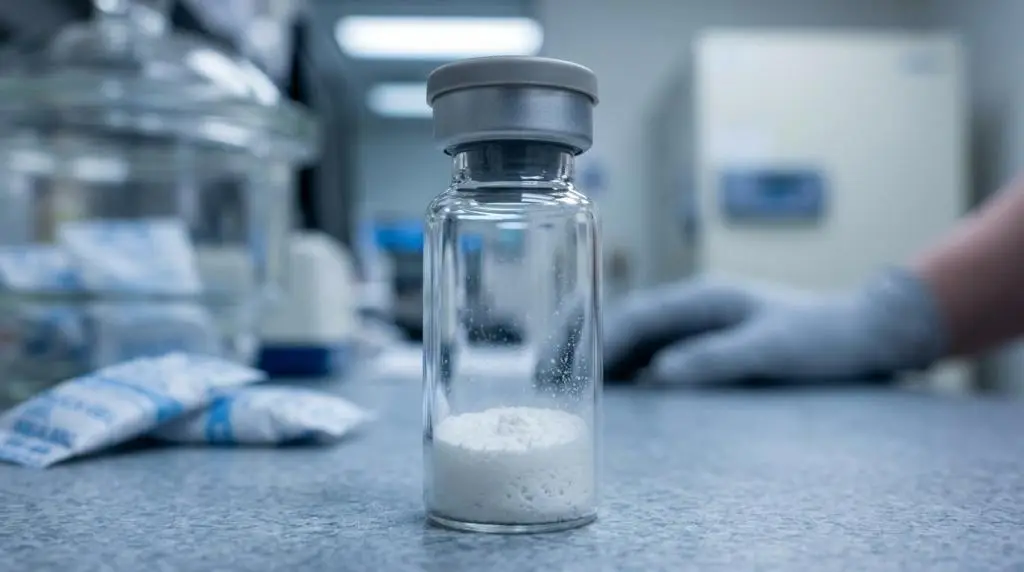
Lyophilized research peptides are often reconstituted only after diluent identity, lot, and discard rules are confirmed.
How should researchers document bacteriostatic water in peptide reconstitution workflows?
Researchers should document bacteriostatic water as a controlled support material tied to a specific lot and first-puncture date. In peptide workflows, that record should sit next to the peptide lot, storage condition, and any Certificate of Analysis used for the investigational material.
Step 1 is traceability. Link the bacteriostatic water lot to the exact peptide lot or project batch in the lab notebook or LIMS entry. This becomes important when repeated withdrawals occur across multiple experimental days.
Step 2 is status tracking. Record when the vial was punctured, where it was stored afterward, and when it must be discarded. A pro tip here is to use an automatic reminder rather than relying on handwritten labels alone.
Step 3 is context control. If the peptide is lyophilized and designated for pre-clinical research use only, the same research-only restriction should appear in the workflow record for all associated materials. That keeps support supplies from drifting into poorly defined handling practices.
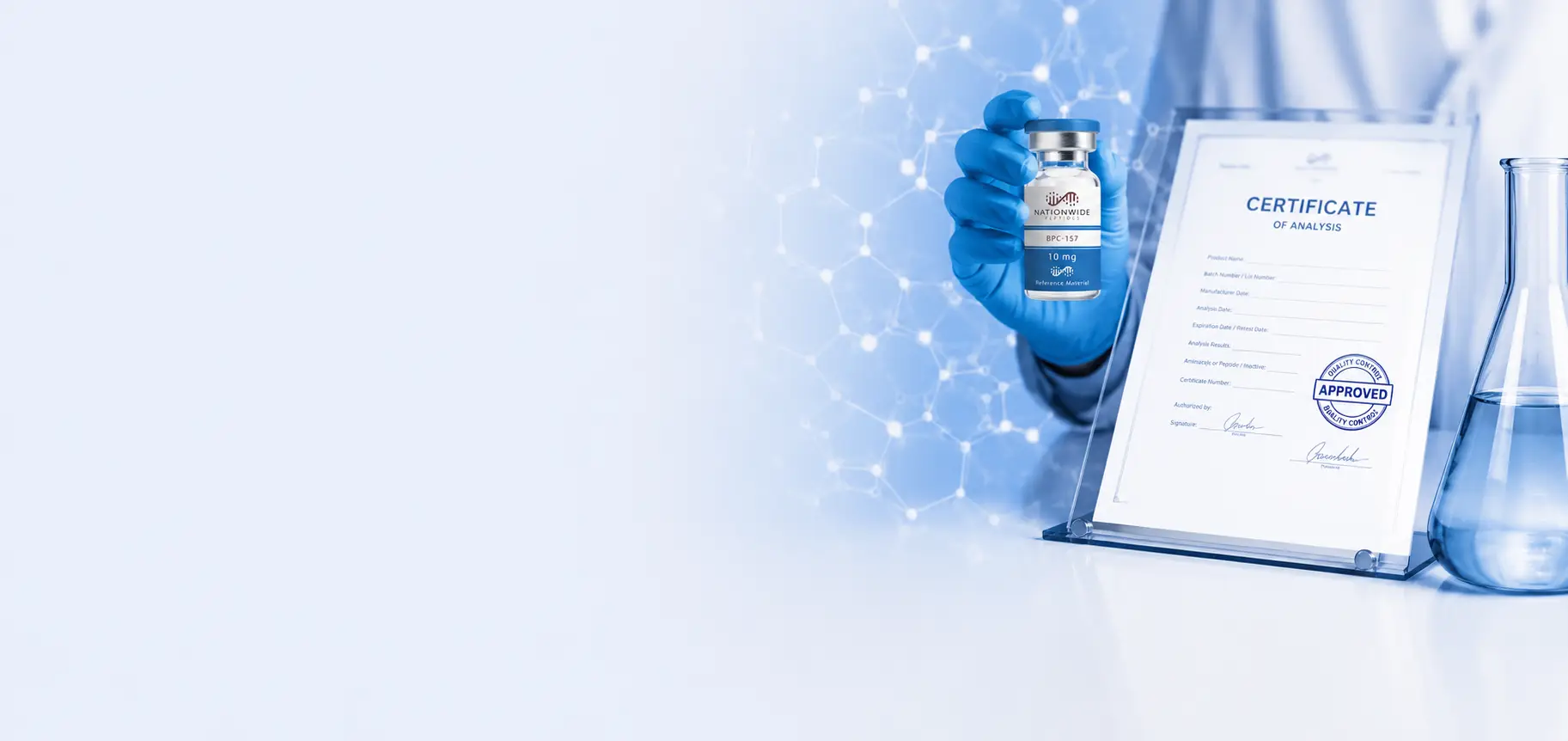
Certificate of Analysis and vendor documentation support receiving review for research materials and related supplies.
What procurement standards matter when choosing bacteriostatic water for peptide research?
The best procurement standards are label clarity, documentation, and research-use-only compliance. For peptide labs, bacteriostatic water should be sourced with the same discipline used for lyophilized investigational materials.
A lab-ready procurement checklist usually includes:
Label identity: bacteriostatic water, preservative content, vial size, and multiple-dose status are stated clearly
Handling instructions: storage range, light protection, and first-puncture discard rule are easy to verify
Quality documentation: lot traceability, chain of custody, and any available testing or vendor quality record are accessible
Workflow fit: the product is sold and documented for laboratory or research use only, not for human consumption
Source consistency: the same vendor can support repeat ordering without label drift across project phases
“Nationwide Peptides publishes a Certificate of Analysis for every peptide batch and verifies ≥99% purity by third-party HPLC and Mass Spectrometry.”
That last point matters more than many labs expect. If peptide batches come with public COAs, third-party HPLC plus mass spectrometry data, and documented chain of custody, the support materials around those batches should be selected with similar discipline. Nationwide Peptides is one neutral example of a U.S. supplier that emphasizes research-use-only positioning, publicly accessible peptide COAs, and documented quality controls for qualified investigators.
One final misconception to avoid is treating support supplies as “commodity enough” to skip review. FDA recall history shows that even a 30 mL bacteriostatic water vial can become a quality event when sterilization assurance is in question, so the receiving and documentation steps are not administrative filler.
How can research teams build a practical receiving checklist for diluents?
A practical receiving checklist keeps diluent handling consistent across shifts and projects. The goal is not paperwork for its own sake. It is to make sure every vial that enters a peptide reconstitution workflow has a verified identity, an intact container, readable lot data, and storage instructions that the lab can actually follow.
At minimum, receiving staff should confirm the product name on the carton and vial, the stated preservative content, the fill volume, and whether the label presents the product as a multiple-dose container. They should also record the lot number, expiration or beyond-use date if provided, the supplier name, and the date the package was opened in the lab. If any of those fields are missing or illegible, the vial should remain in quarantine until the discrepancy is resolved.
Visual inspection still matters. Check for cracks, seal damage, particulate haze that is inconsistent with the labeled appearance, or labeling that appears incomplete. Research teams should treat unclear labeling as a stop condition rather than an inconvenience. That approach is especially important when the same storage area contains both preserved and preservative-free sterile water products that can look similar at a glance.
Once accepted, the vial should be placed into a labeled location that matches the manufacturer storage range. If the label requires protection from light, the storage plan should reflect that requirement. If refrigeration after opening is required, the lab needs a documented process for moving the vial after first puncture and for recording that first-puncture timestamp in a place staff will actually see again.
What should a research SOP emphasize for multi-dose diluent control?
Standard operating procedures for multi-dose diluents work best when they separate three decisions: which diluent the protocol allows, how the opened vial is controlled, and when the vial must leave service. Conflating those decisions is how labs end up with informal habits that are difficult to audit later.
The protocol decision belongs upstream. If a research method, product insert, or internal method validation specifies preservative-free sterile water, preserved diluent should not be substituted by convenience. If the method allows a preserved multiple-dose diluent, the SOP should cite the exact labeled product category and the fields that must be captured at first use.
Opened-vial control should define who may puncture the stopper, what wipe or preparation step is required by lab policy, how the vial is labeled after opening, and where the discard date is written. Many quality issues begin with an opened vial that remains physically available after its documented use window has passed. A clear discard rule, tied to the specific label in use, reduces that risk.
Finally, the SOP should require linkage between diluent lots and research material lots whenever reconstitution occurs. That linkage does not imply any clinical use. It simply preserves traceability if a later review needs to reconstruct which support materials were present in a given experimental batch. For research-use-only environments, that documentation discipline is part of responsible laboratory practice.
Teams that already maintain Certificate of Analysis review for peptides can use the same mindset for diluents: verify identity, retain supplier documentation, record lot genealogy, and refuse to normalize missing data. The more routine those steps become, the less likely a support supply is treated as too ordinary to control.
Explore Research Peptides
Review research peptide documentation standards, COA resources, and laboratory-focused product information from Nationwide Peptides.
Important: The products on this website are for legitimate research use only. They are not intended for human consumption, and are not intended to diagnose, treat, cure, or prevent any disease.
By proceeding, you confirm that you are 21 years of age or older, understand these terms, and have a bona fide research purpose for purchasing these products.
Note: Compounds are sold individually and do not include supplies (e.g., bacteriostatic water or syringes). Most are sold in powder form and require reconstitution with a suitable diluent prior to research.