Fall Special!
Use Code FALL2026 for 10% off Sitewide.
6 Checks Before You Buy CJC 1295 for Research Labs
For Research Use Only. Educational content for laboratory research literacy. Not medical advice; not for human use.
Buying materials for CJC 1295 research is less about price and more about verifying what the vial actually contains. For qualified investigators, the sound approach is documentation first: confirm identity, purity, lot traceability, and strict research-use-only labeling.
CJC 1295 research procurement should start with identity, lot match, and research-use-only labeling checks.
To buy CJC-1295 for research, choose a clearly labeled research peptide with batch-specific identity and purity records, not a vague “wellness” product or a compounded drug substitute.
The most important checks are exact form disclosure, Certificate of Analysis matching the vial lot, third-party HPLC plus Mass Spectrometry, and an explicit statement that the material is for research use only and not for human use.
Form matters because “CJC-1295” is not always labeled consistently; labs should distinguish DAC-containing material from no-DAC material that some suppliers label as modified GRF 1-29.
The FDA has flagged compounded CJC-1295 for concerns that include immunogenicity, peptide-related impurities, API characterization complexity, and reported serious adverse events, so regulatory context should be reviewed before procurement.
A lab should reject any lot with mismatched batch numbers, missing or generic COAs, ambiguous DAC status, damaged lyophilized appearance, or marketing language that implies human consumption.
That matters because CJC 1295 research sits between peptide chemistry, endocrine research, and FDA scrutiny around compounded versions. The questions below focus on what a laboratory should confirm before any pre-clinical purchase, and all discussion here is strictly research-focused, not intended for human use or human consumption.
What is CJC-1295, and why does the exact form matter?
CJC-1295 is a growth hormone-releasing hormone analog, and the exact form matters because DAC and no-DAC materials are not interchangeable. In CJC 1295 research procurement, a label that says only “CJC-1295” is not specific enough.
The scientific literature often refers to CJC-1295 as a long-acting GHRH analog. A 2006 randomized controlled trial in The Journal of Clinical Endocrinology & Metabolism reported multi-day changes in plasma GH and IGF-1 after CJC-1295 exposure, with an estimated half-life of 5.8 to 8.1 days. That kind of kinetic detail is relevant to study design, but it does not mean every vial sold under the same name represents the same construct.
A common mistake is assuming the commercial name fully defines the molecule. Some suppliers separate no-DAC material and label it as modified GRF 1-29, which changes how a lab should map product naming to published protocols and internal SOPs.
“Nationwide Peptides lists its no-DAC material as modified GRF 1-29 and offers 5 mg and 10 mg lyophilized vials for research use only.”
CJC 1295 research peptide documentation checks for laboratory procurement
Quick Answer
Quick research overview
“Nationwide Peptides states each batch is confirmed at ≥99% purity by third-party HPLC and Mass Spectrometry and paired with a per-lot COA.”
6 Checks Before You Buy CJC 1295 for Research Labs
Scientific Snapshot
Research Topic
6 Checks Before You Buy CJC 1295 for Research Labs
Content Type
Laboratory research education guide
Scientific Focus
Documentation, handling, and research literacy
Audience
Qualified research laboratories
Compliance Framing
Research use only / not for human use
Quick Facts
Article Format
Research guide
Primary Theme
6 Checks Before You Buy CJC 1295 for Research Labs
If a protocol cites a long-acting analog, then the procurement file should document whether the intended material includes DAC or not. If that distinction is absent on the product page or COA, the safest move is to pause the order.
Is CJC-1295 appropriate to buy only as a research peptide?
Yes. In the United States, materials for CJC 1295 research should be purchased only as a research peptide for legitimate laboratory work, never as a product for human use.
This is where procurement teams need to separate research supply from consumer-facing marketing. The product label should clearly state research use only and not for human use. If a vendor discusses human dosing, treatment language, performance effects, or casual self-use, that is a compliance red flag rather than a convenience.
FDA context also matters. The FDA has stated that compounded drugs containing CJC-1295 may present significant safety risks and has identified concerns that include immunogenicity, peptide-related impurities, and complexity in active pharmaceutical ingredient characterization. FDA also states that available clinical data are limited. For a research lab, that means the material should be handled as an investigational research reagent, not treated like a conventional therapeutic product.
What are the 6 checks before CJC 1295 research procurement?
The best CJC 1295 research buying checklist is straightforward: verify form, documentation, analytical testing, compliance language, regulatory context, and operational fit before payment or receipt.
Exact product identity: A supplier should disclose whether the material is DAC-containing CJC-1295 or no-DAC material. As one neutral example, Nationwide Peptides states that its no-DAC offering is modified GRF 1-29, a tetrasubstituted GHRH analog, rather than leaving the form ambiguous.
Lot-specific COA: The vial lot number, product name, and batch record should match the Certificate of Analysis exactly.
Orthogonal analytics: Purity by HPLC and identity by Mass Spectrometry should both be documented; one method alone leaves avoidable uncertainty.
Research-only compliance: The listing should clearly state research use only and not for human use or human consumption.
FDA and risk context: The procurement reviewer should understand FDA’s concerns around compounded CJC-1295, including immunogenicity and peptide-related impurities.
One of the most common CJC 1295 research buying errors is treating a purity headline as if it replaces a batch review. A “99% pure” claim without a matching lot number, method details, and identity confirmation is still incomplete documentation.
Price is usually the least important variable once a project enters formal pre-clinical documentation. If the material cannot survive an audit trail, it is not the right purchase.
How do you verify a CJC 1295 research Certificate of Analysis step by step?
Start with the lot number, then verify the method, then confirm the result belongs to the exact vial in hand. For CJC 1295 research purchasing, a real COA is a traceability document, not a marketing graphic.
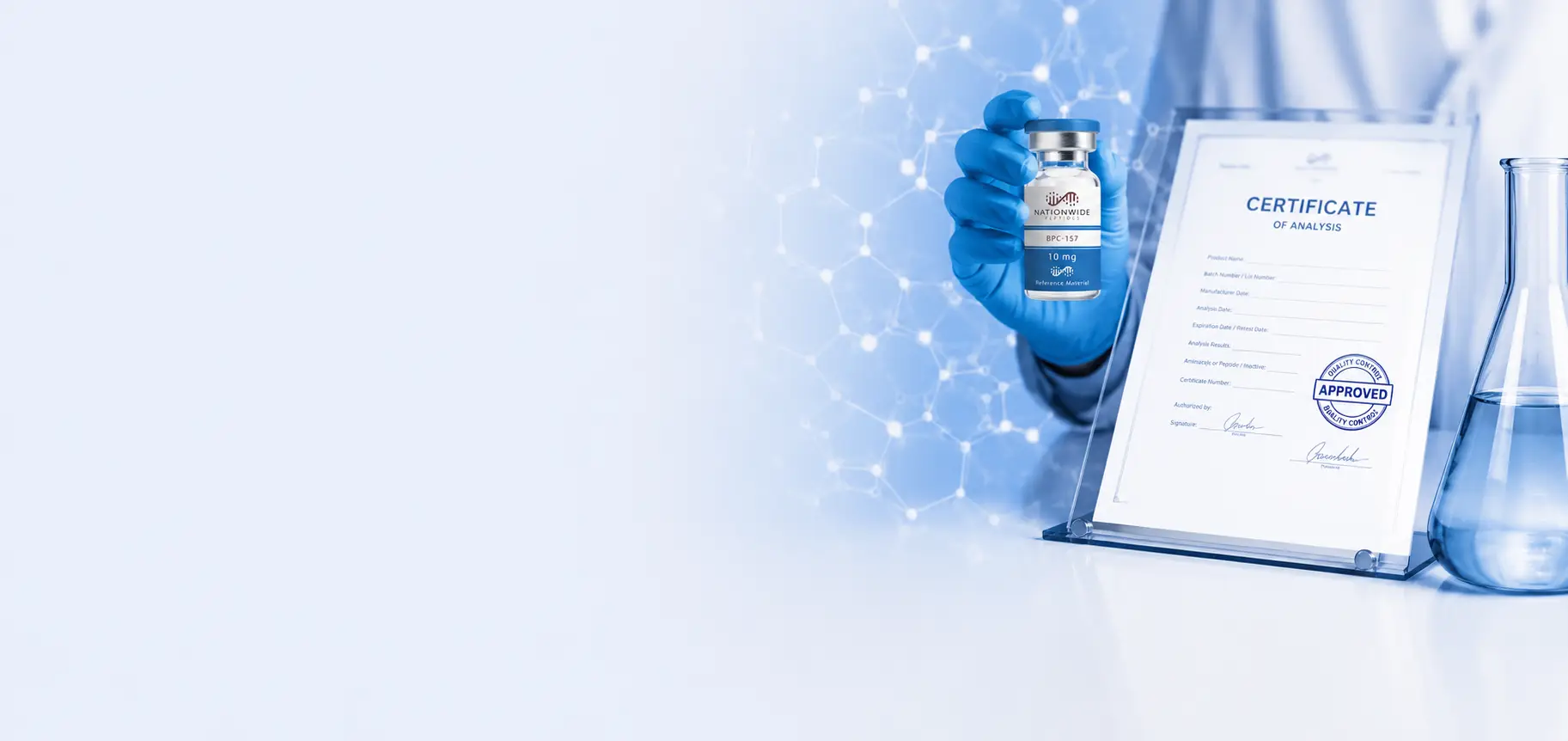
A lot-specific Certificate of Analysis should match the vial batch before laboratory release.
Step 1 is the identity match. The product name, batch or lot number, vial amount, and testing date should match the listing and the label. If the COA refers to a different lot or a generic product family, the document is not sufficient for controlled lab intake.
Step 2 is the analytical review. For peptides, HPLC is commonly used to report purity, while Mass Spectrometry supports structural identity through molecular mass. A lab should look for actual reported results, not just a checkbox that says “passed.” If the method is named but the result is absent, that is a documentation gap.
Step 3 is the provenance check. Determine whether the COA is batch-specific and whether testing is independent or internal. Public COA access can simplify procurement review, but access alone is not the standard. The standard is whether the record can be tied to the material received. A common misconception is that a polished PDF equals a verified batch. It does not.
How do DAC and no-DAC forms compare for CJC 1295 research protocol planning?
DAC and no-DAC materials differ in labeling and likely in kinetic profile, so labs should not map one set of literature assumptions onto the other without documentation. In protocol planning, the comparison is about fit, not preference.
The 2006 clinical trial indexed in PubMed described CJC-1295 as a long-acting GHRH analog and estimated a half-life of 5.8 to 8.1 days. That same paper reported mean plasma GH changes for 6 days or more and IGF-1 changes for 9 to 11 days after single-dose exposure, with above-baseline IGF-1 reported for up to 28 days after multiple doses. Those are study observations from limited human data, not directions for use.
By contrast, some research suppliers label no-DAC material as modified GRF 1-29. That naming distinction matters because a literature search for “CJC-1295” may capture studies of DAC-associated pharmacokinetics that do not cleanly map onto a no-DAC listing. If your protocol depends on pulsatile secretion patterns, exposure duration, or receptor study context, then procurement needs to record which entity the lab actually bought.
What does third-party testing need to show for CJC 1295 research materials?
At minimum, third-party testing for CJC 1295 research materials should show purity and identity through separate analytical methods. For peptides like CJC-1295, HPLC and Mass Spectrometry are the usual baseline pair.
HPLC answers one question well: how much of the sample appears to be the target peak versus detectable impurities under the test conditions used. Mass Spectrometry answers a different question: whether the observed molecular mass matches the expected compound. A lab should want both because purity without identity can still be the wrong peptide, and identity without purity can still be a contaminated lot.
“Nationwide Peptides uses independent third-party testing and makes batch Certificates of Analysis publicly accessible.”
Do not assume that “third-party tested” covers every quality dimension in CJC 1295 research sourcing. It does not automatically address sterility, endotoxin, residual solvents, or stability unless those tests are specifically reported. For pre-clinical research, the analytical package should match the study’s actual risk profile and matrix needs.
How should labs compare vendors for CJC 1295 research step by step?
Compare vendors by documentation quality first, then by supply-chain transparency, then by operational fit. A low-friction checkout process is not a substitute for a clean audit trail.
Step 1 is to map the product disclosure. Does the vendor identify DAC status, vial size, analytical methods, and research-only status in plain language? If basic identity details are buried or missing, expect downstream friction.
Step 2 is to check chain of custody. Many institutional buyers prefer American-owned suppliers with clear batch documentation because that can simplify procurement review and intake logging. The key question is whether the vendor can support traceable handoff from production or fill to shipment.
Step 3 is to evaluate practical fit. Shipping speed, secure ordering, bulk continuity, and support responsiveness matter when a project uses repeat lots or time-sensitive intake windows. Pro tip: continuity across batches is often more valuable than a small price difference if the study will span months.
What FDA safety issues should CJC 1295 research labs review first?
FDA has raised specific concerns about compounded CJC-1295, and those concerns should appear in the procurement review. This is not background noise; it is part of risk assessment.
FDA states that compounded drugs containing CJC-1295 may present significant safety risks and notes concerns that include immunogenicity, peptide-related impurities, and the complexity of API characterization. FDA has also identified serious adverse events associated with CJC-1295, including increased heart rate and systemic vasodilatory reaction, and says available clinical data are limited.
For a research lab, the practical implication is simple. Do not treat a research peptide listing as interchangeable with a compounded clinical product, and do not treat limited human literature as a substitute for a procurement risk review.
After that review, the core FDA-related questions are usually these:
limited clinical data
immunogenicity concerns
peptide-related impurities
API characterization complexity
serious adverse event reports in compounded-drug context
That list is one reason strict research-use-only positioning matters. If a seller blurs the line between investigational material and human use, the compliance risk increases before the box even ships.
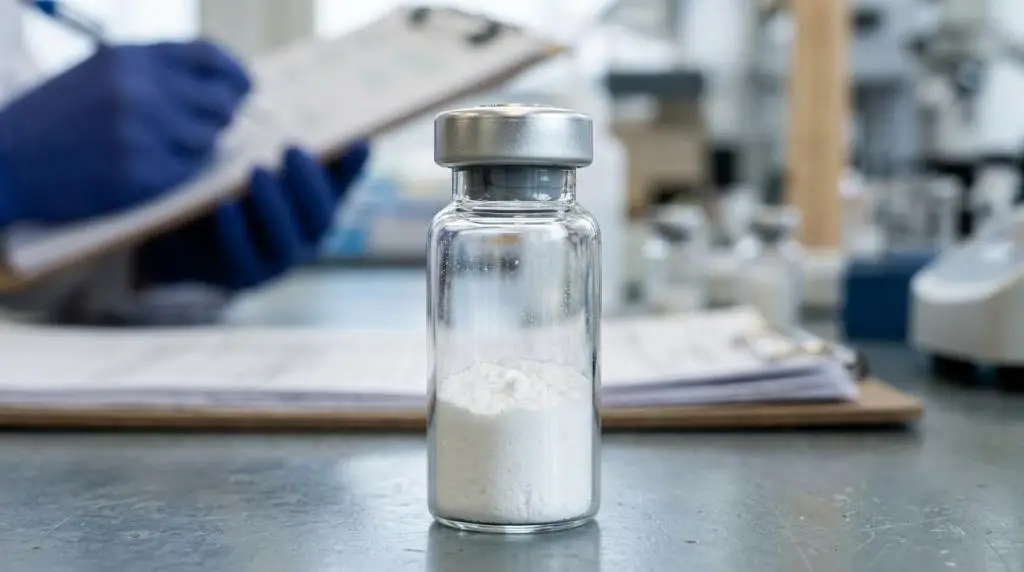
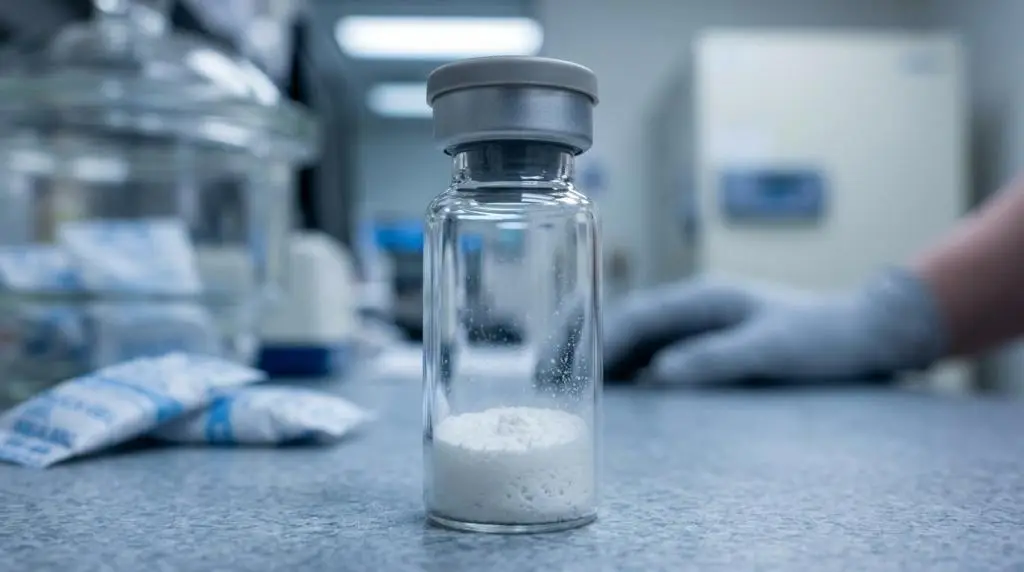
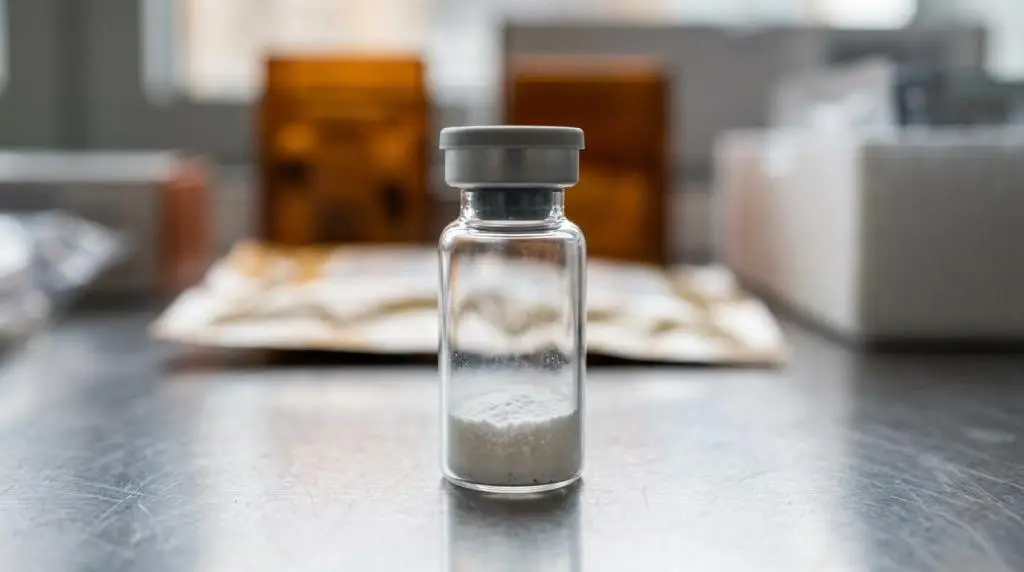
Lyophilized appearance, storage assignment, and chain-of-custody notes belong in the receiving file.
How should a lab receive, log, and store lyophilized CJC 1295 research material?
A lab should inspect, reconcile, and document the lot immediately on receipt. Lyophilized peptides are easier to manage when intake is tied tightly to SOPs and lot control.
Step 1 is physical inspection. Confirm tamper integrity, correct item, vial count, and acceptable appearance of the lyophilized material. A visibly compromised vial, broken seal, or unexplained moisture exposure should trigger hold status.
Step 2 is document reconciliation. Match the purchase order, packing slip, vial label, and COA. Record the batch number, receipt date, storage location, and any deviations in the inventory system. A simple but costly mistake is pooling lots before the first identity and document check is complete.
Step 3 is storage control. Follow the supplier’s storage instructions and internal SOPs, and document any reconstitution event separately from original lot intake. Since these products are for research use only and not for human use, handling should remain fully inside controlled laboratory processes.
How should documentation files be organized for CJC 1295 research orders?
A clean documentation file makes CJC 1295 research procurement reviewable months later. At minimum, keep the purchase order, packing slip, vial label photo or transcription, Certificate of Analysis, and notes on DAC versus no-DAC identity in one lot folder.
That file should also record who approved release into inventory and where the vials were stored. If a later experimental series needs lot reconstruction, the lab should be able to answer without informal email searches. Documentation discipline is part of research quality systems, not an optional purchasing courtesy.
When comparing suppliers for CJC 1295 research, ask whether COAs are public or requestable before payment, whether accession or report identifiers can be verified, and whether the vendor can explain chain of custody without improvisation. Vague answers are procurement data, not minor friction.
What procurement red flags matter most in CJC 1295 research sourcing?
The highest-value red flags are usually documentary. Ambiguous form labeling, generic COAs, unmatched lot numbers, and human-use marketing language should stop a CJC 1295 research order before vials enter active inventory.
Operational red flags matter too: unclear storage guidance, missing research-use-only statements, or an inability to distinguish DAC-containing CJC-1295 from no-DAC material. Those gaps create protocol-mapping risk even when purity numbers look attractive on a sales page.
Laboratories evaluating wholesale or recurring purchasing can apply the same checklist used for other research peptides. For broader supplier-evaluation framing, see Nationwide Peptides’ guide to wholesale peptides for research labs. The core principle stays constant: evidence first, then purchase.
Finally, keep intended-use boundaries explicit in quotes, purchase orders, and receiving notes. CJC 1295 research materials discussed here are for laboratory and investigational research only and are not intended for human use or human consumption.
Before final approval, have a second reviewer confirm that the DAC status, lot identifiers, and research-use-only statements are consistent across the listing, COA, and label transcription. A two-person check is inexpensive insurance for CJC 1295 research programs that will rely on the same supplier across multiple orders.
If any field is missing, keep the material quarantined. CJC 1295 research continuity depends more on trustworthy lot genealogy than on how quickly a package can be opened. That standard protects both documentation quality and later interpretability of laboratory results.
When should a lab reject a CJC 1295 research lot before use?
Reject the lot when identity, documentation, or handling integrity is unclear. In peptide procurement, uncertainty is itself a valid rejection reason.
Inventory control for research peptides should preserve lot genealogy across receiving and release steps.
A lab should not feel pressured to “work around” missing data. If a project needs a defined GHRH analog, then ambiguous naming or partial records weaken the entire experimental chain. This is especially true with products marketed under overlapping terms like CJC-1295 and modified GRF 1-29.
Use rejection criteria that are easy to apply and hard to argue with:
Lot mismatch: The vial, packing slip, and COA do not show the same batch number.
Form ambiguity: The listing does not clarify DAC versus no-DAC status.
Analytical gap: Only one method is provided, or reported results are missing.
Labeling failure: Research-use-only language is absent or contradicted by human-use messaging.
Physical concern: The lyophilized appearance, seal, or shipment condition suggests compromise.
Traceability problem: The vendor cannot provide a batch-specific COA or explain chain of custody.
If any of those conditions apply, the lot should remain on hold or be rejected outright before it enters active bench use.
Taken together, these checks give laboratories a practical way to evaluate CJC 1295 research materials without relying on marketing shorthand.
Explore Research Peptides
Review research peptide documentation standards, COA resources, and laboratory-focused product information from Nationwide Peptides.
Important: The products on this website are for legitimate research use only. They are not intended for human consumption, and are not intended to diagnose, treat, cure, or prevent any disease.
By proceeding, you confirm that you are 21 years of age or older, understand these terms, and have a bona fide research purpose for purchasing these products.
Note: Compounds are sold individually and do not include supplies (e.g., bacteriostatic water or syringes). Most are sold in powder form and require reconstitution with a suitable diluent prior to research.