
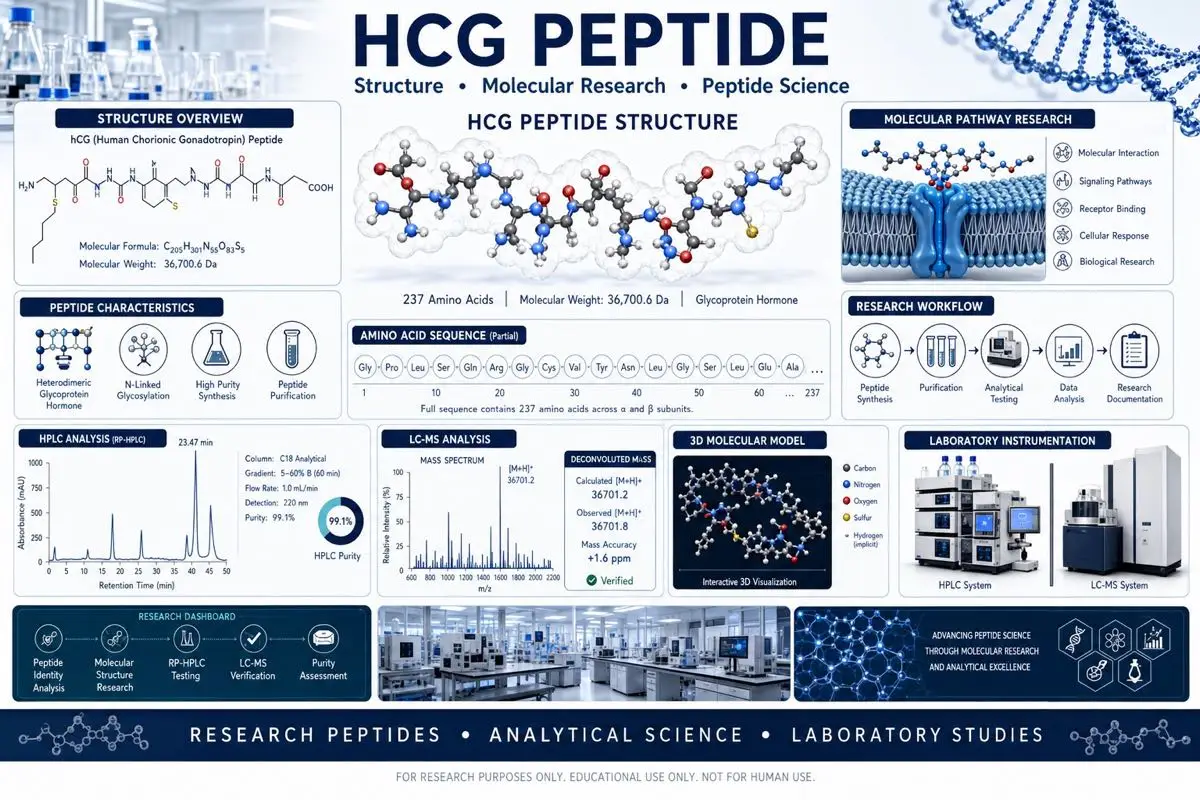
For Research Use Only. Educational content for laboratory research literacy. Not medical advice; not for human use.
Quick Answer
Is HCG a Peptide?
Laboratories reviewing an HCG peptide query should start with classification. Although many people search for the term “HCG peptide”, human chorionic gonadotropin (hCG) is scientifically classified as a glycoprotein hormone rather than a true HCG peptide. An HCG peptide search term usually maps to glycoprotein hormone literature. Researchers investigate hCG to better understand hormone-receptor interactions relevant to HCG peptide questions, protein structure, molecular signaling pathways, and analytical characterization using modern laboratory techniques.
HCG Peptide Explained: Human Chorionic Gonadotropin Research, Molecular Biology & Scientific Analysis
Scientific Snapshot
| Research Compound | Human Chorionic Gonadotropin (hCG) |
| Scientific Classification | Glycoprotein Hormone |
| Primary Research Area | Hormone Biology, Receptor Signaling & Protein Structure |
| Molecular Composition | Alpha and Beta Protein Subunits with Glycosylation |
| Analytical Evaluation | LC-MS, RP-HPLC & Protein Characterization |
Quick Facts
| Common Name | Human Chorionic Gonadotropin (hCG) |
| Research Category | Glycoprotein Hormone Research |
| Protein Structure | Alpha and Beta Glycoprotein Subunits |
| Scientific Interest | Hormone Signaling, Molecular Biology & Receptor Research |
| Research Methods | Protein Characterization, LC-MS & Computational Biology |
Key Takeaways
- Despite the common search term “HCG peptide”, hCG is scientifically recognized as a glycoprotein hormone rather than a peptide.
- Researchers investigate human chorionic gonadotropin to better understand hormone-receptor interactions, molecular signaling pathways, and protein structure.
- Analytical techniques including LC-MS, RP-HPLC, and computational modeling support molecular characterization and structural research.
- studying HCG peptide search topics and hCG peptide search topics and hCG alongside peptide-based research compounds helps scientists understand similarities and differences between glycoprotein hormones and engineered peptides.
Table of Contents
- What Is Human Chorionic Gonadotropin (hCG)?
- Is an HCG Peptide Classification Accurate?
- Protein Structure and Glycoprotein Classification
- Hormone Receptor Biology in HCG Peptide Discussions
- Analytical Characterization and Laboratory Testing
- Future HCG Peptide Research Directions
- Scientific Resources & References
Introduction
Searches for “HCG peptide” have increased significantly in recent years, yet the terminology can be misleading. From a scientific perspective, human chorionic gonadotropin (hCG) is not a peptide. Instead, it belongs to the family of glycoprotein hormones—complex protein molecules composed of alpha and beta subunits with attached carbohydrate chains.
Understanding this distinction is important because peptides and glycoprotein hormones differ in molecular structure, biosynthesis, and biological classification. While both are investigated within molecular biology and biochemical research, they represent separate categories of signaling molecules with unique structural characteristics.
Researchers study hCG to investigate receptor biology, protein folding, molecular signaling pathways, structural biology, and hormone interactions. Modern analytical technologies—including LC-MS, RP-HPLC, protein characterization methods, and computational modeling—provide detailed insights into its molecular composition and biochemical properties.
This Nationwide Peptides research guide explains why the phrase “what is hCG peptide” is commonly searched, clarifies the scientific classification of human chorionic gonadotropin, and explores current research surrounding protein structure, analytical characterization, and hormone biology.
Research Note
Why Does the Internet Call It an HCG Peptide?
Many online sources group hCG alongside research peptides because both are commonly discussed within laboratory research communities. Scientifically, however, human chorionic gonadotropin is classified as a glycoprotein hormone. This guide uses the popular search term “HCG peptide” for educational and SEO purposes while maintaining accurate scientific terminology throughout.
What Is Human Chorionic Gonadotropin (hCG)?
Human chorionic gonadotropin (hCG) is a naturally occurring glycoprotein hormone that has been extensively studied in molecular biology, endocrinology, reproductive biology, and protein chemistry. Although many internet searches refer to “HCG peptide”, the scientific classification is different. hCG belongs to the glycoprotein hormone family rather than the peptide family.
Researchers investigate hCG to better understand hormone-receptor interactions, protein folding, molecular signaling pathways, glycosylation patterns, and structural biology. These investigations contribute to broader scientific knowledge regarding protein hormones and cellular communication.
Understanding this distinction helps researchers interpret scientific literature more accurately while improving discussions surrounding hormone biology and laboratory research.
Scientific Insight
Why Is an HCG Peptide Label Common Online?
The phrase “HCG peptide“ has become a common search term because hCG is frequently discussed alongside research peptides in laboratory catalogs and educational resources. Scientifically, however, hCG is classified as a glycoprotein hormone composed of protein subunits with carbohydrate modifications.
Is hCG a Peptide?
One of the most common questions researchers ask is “Is hCG a peptide?” The scientific answer is no. Human chorionic gonadotropin is classified as a glycoprotein hormone because its molecular structure consists of two protein subunits—an alpha subunit and a beta subunit—with attached carbohydrate chains.
Peptides are generally shorter chains of amino acids, whereas glycoprotein hormones are larger and possess additional carbohydrate components that influence molecular stability, receptor recognition, and biological function.
| Scientific Feature | Peptide | Human Chorionic Gonadotropin (hCG) |
|---|---|---|
| Molecular Classification | Peptide | Glycoprotein Hormone |
| Primary Structure | Amino acid chain | Protein subunits with carbohydrate groups |
| Molecular Complexity | Relatively smaller molecules | Larger multi-subunit protein hormone |
| Research Focus | Peptide biology | Hormone signaling and receptor biology |
Molecular Structure of Human Chorionic Gonadotropin
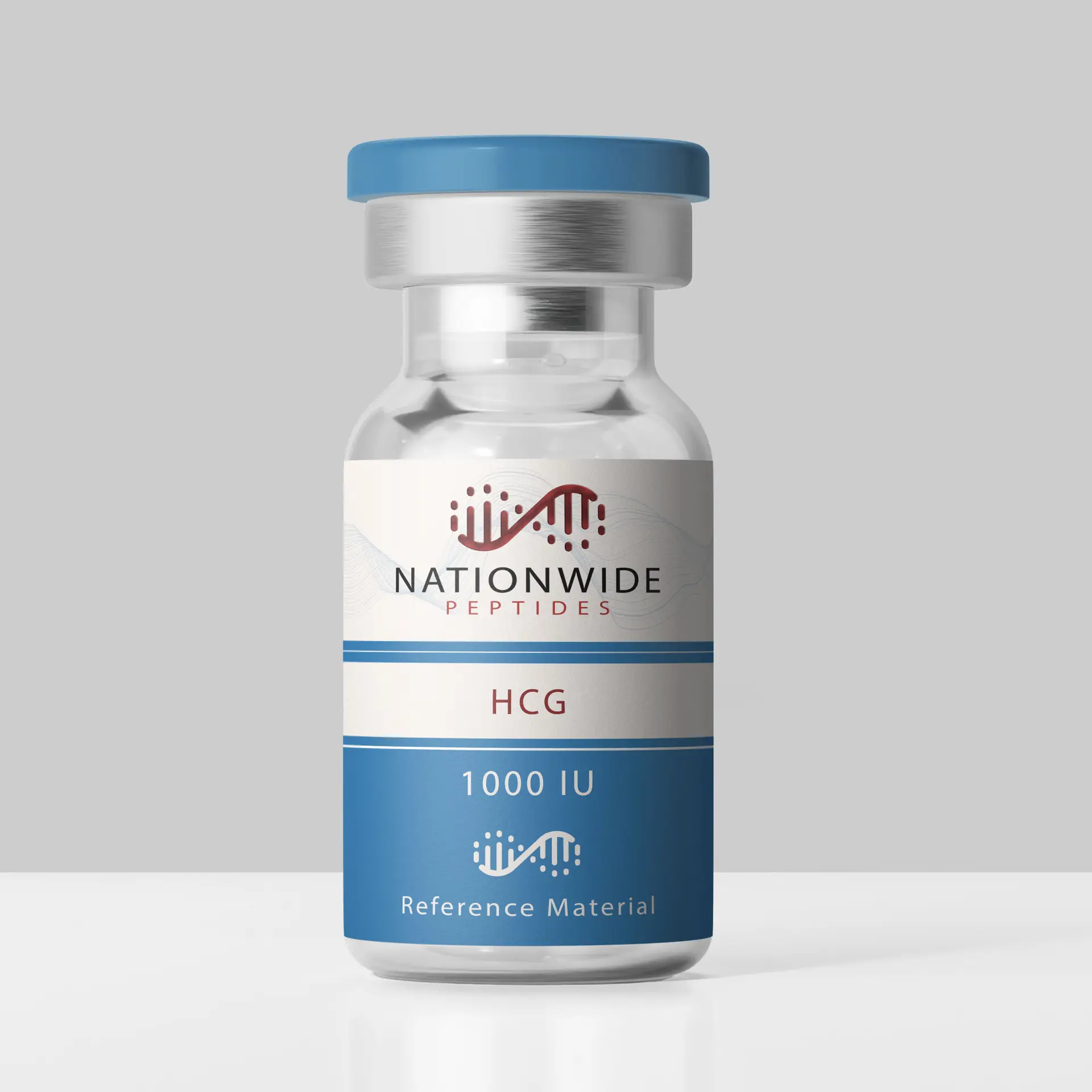
Researchers studying human chorionic gonadotropin investigate its three-dimensional protein architecture, glycosylation patterns, and receptor-binding characteristics. The alpha and beta subunits work together to create the complete glycoprotein hormone structure examined in molecular biology research.
Protein structure analysis, computational modeling, and biochemical characterization help scientists understand how molecular organization influences receptor interactions and structural stability.
| Structural Component | Scientific Significance |
|---|---|
| Alpha Subunit | Shared structural component among several glycoprotein hormones |
| Beta Subunit | Provides molecular specificity for hCG |
| Glycosylation Sites | Influence protein stability and molecular properties |
| Three-Dimensional Structure | Supports receptor interaction research |
Hormone Receptor Biology and Molecular Research
Scientific investigations involving hCG focus on receptor biology, molecular signaling pathways, and protein interaction networks. Researchers study how glycoprotein hormones communicate with specific receptor systems through highly regulated molecular processes.
Advances in structural biology, computational modeling, and analytical chemistry continue improving scientific understanding of hormone-receptor interactions and protein signaling mechanisms.
| Research Area | Scientific Investigation |
|---|---|
| Receptor Biology | Hormone-receptor interaction studies |
| Protein Chemistry | Structural characterization |
| Molecular Biology | Cellular signaling investigations |
| Computational Biology | Protein structure modeling |
hCG Research Within the Broader Molecular Biology Landscape
Although hCG is not classified as a peptide, it is frequently discussed alongside peptide-based research because both areas contribute to molecular biology, analytical chemistry, and receptor signaling research. Comparative studies help scientists understand the structural and functional differences between peptide molecules and glycoprotein hormones.
This broader scientific perspective strengthens research into protein engineering, analytical characterization, computational biology, and molecular communication systems.
Did You Know?
hCG Contains Carbohydrate Groups That Peptides Typically Do Not
One defining feature of glycoprotein hormones such as hCG is the presence of carbohydrate (glycan) chains attached to their protein structure. These glycosylation patterns contribute to molecular stability and are an important reason why hCG is classified as a glycoprotein hormone instead of a peptide.
Section Summary
Human chorionic gonadotropin (hCG) is scientifically classified as a glycoprotein hormone rather than a peptide. Research focuses on protein structure, receptor biology, glycosylation, molecular signaling, and analytical characterization. Clarifying this distinction improves scientific accuracy while helping readers understand why the search term “HCG peptide” remains common despite its technical inaccuracy.
Human Chorionic Gonadotropin (hCG) Receptor Biology Research
Research involving human chorionic gonadotropin (hCG) focuses on hormone-receptor interactions, molecular signaling pathways, and protein communication networks. Although many users search for “HCG peptide”, scientific investigations classify hCG as a glycoprotein hormone and examine how its molecular structure influences receptor recognition and downstream signaling.
Scientists investigate the structural relationship between the alpha and beta protein subunits and their interactions with specific receptor systems using molecular biology, structural biochemistry, and computational modeling techniques.
These studies contribute to a broader understanding of glycoprotein hormone biology, protein architecture, and receptor-mediated molecular communication.
Research Insight
Protein Hormones and Peptides Use Different Molecular Architectures
Although protein hormones and peptides both participate in biological signaling, they differ substantially in molecular complexity. Glycoprotein hormones such as hCG contain multiple protein subunits and carbohydrate groups, whereas peptides are typically shorter amino acid chains without glycosylation.
Hormone-Receptor Interaction Studies
A major area of hCG research involves understanding how glycoprotein hormones recognize and interact with cellular receptors. Researchers analyze receptor-binding regions, molecular conformation, and protein flexibility to better understand signaling mechanisms at the molecular level.
Advances in cryo-electron microscopy, molecular simulations, and computational biology continue providing increasingly detailed insights into hormone-receptor complexes.
| Research Area | Scientific Focus |
|---|---|
| Receptor Recognition | Protein-receptor interaction studies |
| Molecular Signaling | Cell communication pathway research |
| Structural Biology | Protein conformation analysis |
| Computational Modeling | Digital simulation of molecular interactions |
Molecular Signaling Pathways in HCG peptide related research
Researchers investigate how human chorionic gonadotropin participates in complex molecular signaling systems by studying receptor activation, intracellular communication, and protein interaction networks. These investigations provide valuable insights into hormone biology and molecular regulation.
Experimental models allow scientists to evaluate signaling dynamics while integrating analytical chemistry, structural biology, and computational research methods.
| Scientific Topic | Research Objective |
|---|---|
| Protein Signaling | Investigation of molecular communication |
| Receptor Biology | Analysis of binding interactions |
| Structural Dynamics | Protein conformation studies |
| Systems Biology | Integrated molecular pathway analysis |
HCG Peptide vs Glycoprotein Hormone Research
The popularity of searches such as “what is HCG peptide” highlights the need to distinguish peptides from glycoprotein hormones. While both are investigated within molecular biology, they differ in structural organization, biosynthesis, molecular size, and biochemical properties.
Understanding these differences improves scientific communication and helps researchers accurately interpret laboratory findings involving protein hormones and peptide-based compounds.
| Comparison | Peptides | hCG |
|---|---|---|
| Scientific Classification | Peptide molecule | Glycoprotein hormone |
| Molecular Composition | Amino acid chain | Protein subunits with glycans |
| Primary Research Area | Peptide biology | Hormone biology |
| Analytical Focus | Peptide characterization | Protein characterization |
Computational Biology in HCG Peptide Structural Research
Artificial intelligence and computational biology have transformed protein research by enabling detailed structural predictions, molecular dynamics simulations, and receptor interaction modeling. Researchers use these technologies to better understand the three-dimensional organization of glycoprotein hormones such as hCG.
These computational approaches complement laboratory-based investigations and support ongoing research into protein folding, receptor biology, and molecular communication systems.
Did You Know?
Cryo-EM Has Revolutionized Protein Structure Research
Modern cryo-electron microscopy enables scientists to visualize complex protein structures at near-atomic resolution, providing valuable insights into glycoprotein hormones, receptor interactions, and molecular signaling mechanisms.
Section Summary
Research involving human chorionic gonadotropin focuses on receptor biology, glycoprotein hormone signaling, structural biology, and computational modeling. While the search phrase “HCG peptide” remains common, scientific evidence clearly classifies hCG as a glycoprotein hormone with distinct structural and functional characteristics compared with peptides.
Human Chorionic Gonadotropin (hCG) Molecular Characterization
Scientific investigations involving human chorionic gonadotropin (hCG) rely on advanced analytical techniques to evaluate protein structure, molecular composition, glycosylation patterns, and biochemical properties. Although the phrase “HCG peptide” is widely searched, laboratory investigations focus on hCG as a glycoprotein hormone rather than a peptide molecule.
Researchers combine complementary analytical technologies to characterize protein identity, evaluate structural integrity, and investigate molecular features under controlled laboratory conditions.
Modern workflows frequently integrate liquid chromatography-mass spectrometry (LC-MS), reverse-phase high-performance liquid chromatography (RP-HPLC), electrophoretic techniques, glycoprotein analysis, and computational biology to generate comprehensive molecular profiles.
Quality Science Insight
Protein Characterization Requires Multiple Complementary Analytical Methods
Unlike smaller peptide molecules, glycoprotein hormones require several analytical techniques to investigate protein sequence, glycosylation, molecular mass, structural conformation, and biochemical consistency. Combining orthogonal methods improves scientific confidence and data quality.
Protein Biosynthesis and Structural Characterization
Human chorionic gonadotropin research includes investigations into protein biosynthesis, post-translational glycosylation, structural organization, and molecular folding. Researchers evaluate how these characteristics contribute to the overall architecture of the glycoprotein hormone.
Structural characterization provides valuable information about protein organization and supports molecular biology, structural biochemistry, and receptor interaction research.
| Research Stage | Scientific Objective |
|---|---|
| Protein Biosynthesis | Investigation of molecular assembly |
| Glycosylation Analysis | Characterization of carbohydrate modifications |
| Protein Folding | Evaluation of three-dimensional structure |
| Molecular Characterization | Comprehensive biochemical analysis |
LC-MS Analysis in HCG peptide related research
Liquid chromatography-mass spectrometry (LC-MS) is widely used to investigate protein identity, molecular mass, glycosylation patterns, and structural characteristics. Researchers analyze experimental data to better understand the molecular composition of human chorionic gonadotropin.
Within hCG research, LC-MS supports analytical characterization by providing detailed information about protein composition and molecular features generated during laboratory investigations.
| LC-MS Evaluation | Scientific Contribution |
|---|---|
| Protein Identity | Molecular verification research |
| Molecular Mass | Characterization of protein composition |
| Glycosylation Profile | Analysis of carbohydrate modifications |
| Analytical Documentation | Generation of laboratory data |
RP-HPLC and HCG Peptide Purity Evaluation
Reverse-phase high-performance liquid chromatography (RP-HPLC) is used to evaluate chromatographic behavior, molecular composition, and analytical consistency during protein characterization. Researchers combine RP-HPLC with complementary analytical methods to investigate structural quality and biochemical properties.
Chromatographic analysis contributes to reproducible laboratory investigations by supporting detailed evaluation of glycoprotein hormone preparations.
| RP-HPLC Analysis | Research Application |
|---|---|
| Chromatographic Profile | Protein separation analysis |
| Molecular Composition | Evaluation of analytical consistency |
| Purity Investigation | Characterization of protein preparations |
| Research Documentation | Generation of chromatographic records |
HCG Peptide Stability and Structural Integrity Research
Protein stability studies investigate how molecular structure, environmental conditions, and glycosylation influence structural integrity over time. Researchers examine these properties to better understand protein behavior during laboratory investigations.
Experimental stability research contributes to broader investigations involving glycoprotein hormones, structural biology, and analytical biochemistry.
Analytical Quality Standards for Glycoprotein Hormone Research
Reliable scientific investigations depend on rigorous analytical workflows, standardized laboratory methods, and comprehensive documentation. Researchers integrate multiple analytical platforms to improve reproducibility and molecular characterization.
Studies involving human chorionic gonadotropin benefit from combining LC-MS, RP-HPLC, protein characterization techniques, glycosylation analysis, and computational modeling to generate high-quality scientific datasets.
| Quality Evaluation Area | Analytical Focus |
|---|---|
| Protein Identity | LC-MS molecular verification |
| Structural Integrity | Protein characterization studies |
| Glycosylation Assessment | Carbohydrate profile analysis |
| Analytical Documentation | Laboratory quality records |
Did You Know?
Glycosylation Is One of the Defining Features of hCG
Researchers devote significant attention to glycosylation because carbohydrate modifications influence the molecular characteristics, structural stability, and analytical profile of glycoprotein hormones such as human chorionic gonadotropin.
Section Summary
Human chorionic gonadotropin research relies on protein characterization, LC-MS analysis, RP-HPLC evaluation, glycosylation studies, and stability investigations to improve scientific understanding of glycoprotein hormone structure and molecular biology. These complementary analytical approaches provide a comprehensive framework for laboratory-based protein research.
Research Compound Profile
HCG Peptide Research Profile and Classification
Nationwide Peptides publishes research-focused educational resources to support laboratories, researchers, and scientific organizations investigating protein hormones, molecular biology, receptor signaling, and analytical characterization. The information presented emphasizes evidence-based laboratory science and modern analytical methodologies.
Although many researchers search for “HCG peptide”, human chorionic gonadotropin is scientifically classified as a glycoprotein hormone. Research involving hCG focuses on protein structure, receptor biology, glycosylation, molecular characterization, and biochemical analysis.
| Research Attribute | Scientific Profile |
|---|---|
| Compound Name | Human Chorionic Gonadotropin (hCG) |
| Scientific Classification | Glycoprotein Hormone |
| Research Category | Protein Hormone Research |
| Primary Research Focus | Receptor Biology, Protein Structure & Molecular Signaling |
| Analytical Methods | LC-MS, RP-HPLC & Protein Characterization |
Analytical Standards in hCG Research

Research involving human chorionic gonadotropin depends on comprehensive analytical characterization to evaluate protein identity, structural integrity, glycosylation, and biochemical consistency. Multiple complementary analytical techniques are used to generate reproducible laboratory data.
Rather than relying on a single analytical method, researchers integrate chromatography, mass spectrometry, protein characterization, and computational modeling to investigate glycoprotein hormone structure and molecular properties.
| Quality Research Area | Scientific Evaluation Method |
|---|---|
| Protein Identity | Mass spectrometry-based verification |
| Structural Characterization | Protein conformation analysis |
| Glycosylation Assessment | Carbohydrate profile characterization |
| Analytical Documentation | Comprehensive laboratory reporting |
Quality Verification Insight
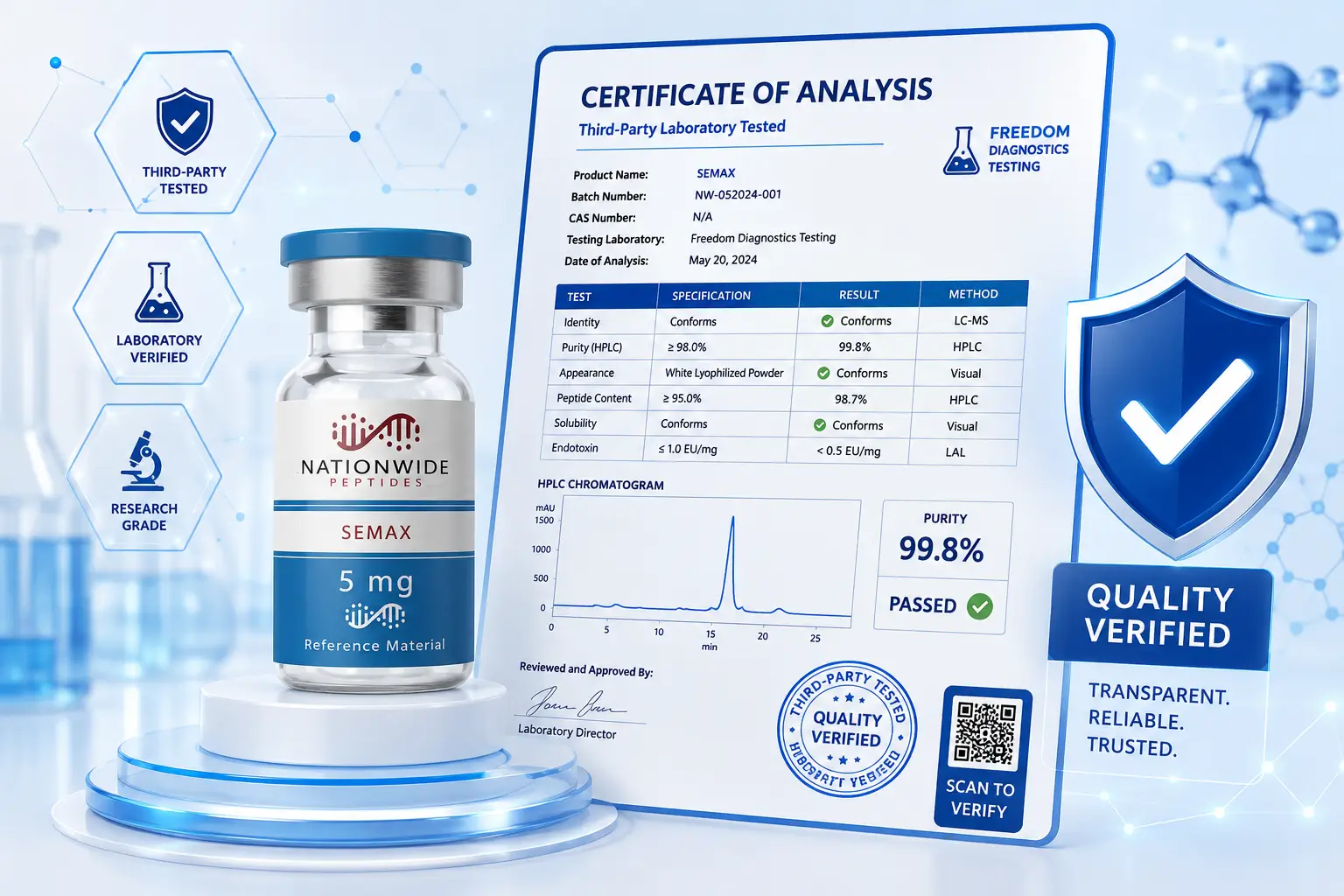
Independent Analytical Testing for HCG Peptide Transparency
Third-party analytical laboratories provide independent evaluation of molecular identity and analytical characteristics using established scientific methods. Independent testing supports reproducibility, documentation quality, and confidence in laboratory-generated data.
Nationwide Peptides supports research transparency through analytical documentation and Certificate of Analysis (COA) information where applicable for research compounds.
Certificate of Analysis (COA) Documentation

A Certificate of Analysis (COA) summarizes laboratory-generated analytical information associated with a research compound. Researchers use COA documentation to review analytical methodologies, identity verification, chromatographic results, and other quality-related laboratory data.
For protein hormone research, COA documentation complements structural characterization by providing traceable analytical records that support scientific investigations.
| COA Information | Scientific Importance |
|---|---|
| Identity Verification | Confirms molecular characterization |
| Analytical Methods | Documents laboratory techniques |
| Chromatographic Results | Supports analytical interpretation |
| Research Traceability | Improves scientific documentation |
hCG Research Within Modern Molecular Biology
Human chorionic gonadotropin research contributes to several scientific disciplines, including molecular biology, structural biochemistry, endocrinology, computational biology, and analytical chemistry. Although hCG differs structurally from peptide molecules, comparative studies help researchers understand diverse biological signaling systems.
Integrating protein hormone research with peptide science provides broader insight into receptor biology, molecular recognition, and advanced analytical characterization techniques.
| Scientific Discipline | Research Contribution |
|---|---|
| Protein Chemistry | Protein structure and folding investigations |
| Structural Biology | Three-dimensional molecular analysis |
| Analytical Chemistry | LC-MS and RP-HPLC characterization |
| Computational Biology | AI-assisted protein modeling |
Explore Protein Hormone and Molecular Biology Research
Discover more educational resources covering protein hormones, molecular characterization, analytical testing, receptor biology, and laboratory research through the Nationwide Peptides research library. Explore Research Resources
Research Use Statement
Information relating to human chorionic gonadotropin (hCG) is provided exclusively for laboratory research and educational purposes. Content is intended to support scientific understanding of molecular biology, protein chemistry, analytical characterization, and experimental research. It is not intended for human consumption applications, diagnosis, treatment, or clinical use.
Did You Know?
Protein Hormones Often Require More Complex Analytical Workflows Than Peptides
Because glycoprotein hormones contain multiple protein subunits and carbohydrate modifications, researchers frequently combine several complementary analytical techniques to obtain a comprehensive understanding of their molecular characteristics.
Future Directions in Human Chorionic Gonadotropin (hCG) Research
Research involving human chorionic gonadotropin (hCG) continues to evolve through advances in structural biology, protein chemistry, computational modeling, and analytical science. Although many online searches use the phrase “HCG peptide”, ongoing scientific investigations focus on hCG as a glycoprotein hormone with unique molecular characteristics and complex protein architecture.
Emerging technologies now allow researchers to investigate protein folding, glycosylation patterns, receptor recognition, and molecular interactions with greater precision than ever before. These developments continue expanding scientific understanding of hormone biology and protein signaling systems.
Future discoveries are expected to combine experimental laboratory techniques with artificial intelligence and high-resolution structural analysis to improve protein characterization and molecular research workflows.
Research Insight
Artificial Intelligence Is Transforming Protein Structure Research
Machine learning and AI-powered structural prediction platforms are enabling researchers to investigate complex protein architectures, receptor interactions, and molecular dynamics with unprecedented speed and accuracy, complementing traditional laboratory experimentation.
AI Protein Structure Modeling and hCG Research
Artificial intelligence has become an increasingly valuable tool for investigating large biomolecules such as glycoprotein hormones. Researchers use computational biology platforms to model protein conformations, analyze amino acid sequences, and simulate receptor interactions before validating findings experimentally.
For human chorionic gonadotropin research, AI-assisted modeling supports investigations into protein folding, glycosylation patterns, structural stability, and receptor-binding mechanisms while complementing analytical laboratory methods.
| Technology | Research Contribution |
|---|---|
| AI Structure Prediction | Protein conformation modeling |
| Computational Biology | Protein interaction analysis |
| Machine Learning | Large-scale molecular data interpretation |
| Bioinformatics | Protein sequence analysis |
Future of Glycoprotein Hormone Research
Scientists continue exploring the structural diversity of glycoprotein hormones to better understand receptor biology, molecular recognition, and biochemical communication systems. Future research is expected to integrate structural biology, computational chemistry, and high-resolution analytical techniques to generate increasingly detailed molecular insights.
Comparative investigations involving glycoprotein hormones and peptide-based signaling molecules also contribute to broader scientific understanding of cellular communication and molecular regulation.
| Future Research Area | Scientific Direction |
|---|---|
| Protein Engineering | Advanced structural biology research |
| Receptor Biology | Improved molecular interaction studies |
| Analytical Technologies | Higher-resolution protein characterization |
| Computational Science | AI-assisted molecular modeling |
Emerging Technologies in Protein Characterization
Advances in analytical instrumentation continue improving protein characterization by providing higher sensitivity, greater molecular resolution, and more detailed structural information. Researchers increasingly combine multiple complementary technologies to produce comprehensive analytical datasets.
| Emerging Technology | Research Application |
|---|---|
| High-Resolution LC-MS | Detailed protein identity analysis |
| Advanced RP-HPLC | Improved chromatographic characterization |
| Cryo-Electron Microscopy | Near-atomic structural visualization |
| AI Research Platforms | Integrated computational protein analysis |
Protein Hormone Research Within the Broader Molecular Science Landscape
Human chorionic gonadotropin research contributes to a multidisciplinary scientific landscape encompassing structural biology, analytical chemistry, computational biology, endocrinology, and molecular biophysics. These interconnected fields help researchers understand increasingly complex biological systems.
Although hCG is structurally distinct from peptides, comparing glycoprotein hormones with peptide signaling molecules provides valuable scientific context for investigating molecular communication, receptor specificity, and protein evolution.
Related Nationwide Peptides Research Topics
Continue Exploring Molecular Biology Research
Expand your understanding of protein hormones, peptide science, analytical chemistry, and computational biology through related educational resources.
Research Foundations
Analytical Science
Did You Know?
AI Can Predict Protein Structures with Remarkable Accuracy
Modern AI systems such as AlphaFold have significantly advanced structural biology by enabling highly accurate predictions of protein three-dimensional structures, accelerating research across molecular biology and biochemistry.
Section Summary
Future research involving human chorionic gonadotropin will continue benefiting from advances in artificial intelligence, structural biology, analytical chemistry, and computational modeling. These technologies are expanding scientific understanding of glycoprotein hormones while strengthening laboratory-based investigations into molecular structure, receptor biology, and protein characterization.
Lab Checklist
HCG Peptide Intake Checklist for Research Teams
When an HCG peptide order arrives, confirm lot numbers, seal integrity, and matching analytical files before materials enter shared inventory. Clear intake notes reduce later ambiguity during audits.
Keep HCG peptide terminology in purchasing notes separate from glycoprotein hormone classification language used in experimental protocols. That separation prevents documentation drift between procurement and bench teams.
Archive HCG peptide related COAs with the same filename conventions used for other research materials so retrieval stays consistent across projects.
Frequently Asked Questions About Human Chorionic Gonadotropin (hCG)
1. Is hCG a peptide?
No. Although many people search for “HCG peptide”, human chorionic gonadotropin (hCG) is scientifically classified as a glycoprotein hormone. It consists of alpha and beta protein subunits with attached carbohydrate chains, distinguishing it from peptide molecules.
2. Why do people search for “HCG peptide”?
The phrase “HCG peptide” has become a common online search term because hCG is frequently discussed alongside research peptides. Scientifically, however, it belongs to the glycoprotein hormone family rather than the peptide family.
3. What is human chorionic gonadotropin (hCG)?
Human chorionic gonadotropin is a glycoprotein hormone studied in molecular biology, endocrinology, structural biochemistry, and receptor signaling research. Scientists investigate its protein structure, glycosylation, receptor interactions, and analytical characteristics.
4. How is hCG different from a peptide?
Peptides are generally shorter amino acid chains, whereas hCG is a larger glycoprotein hormone composed of multiple protein subunits with carbohydrate modifications. These structural differences influence molecular classification and analytical research methods.
5. What does hCG research focus on?
Research involving hCG focuses on receptor biology, molecular signaling pathways, protein structure, glycosylation analysis, analytical characterization, and computational modeling.
6. What analytical techniques are used to study hCG?
Researchers commonly use LC-MS, RP-HPLC, protein characterization techniques, electrophoretic analysis, structural biology methods, and computational modeling to investigate human chorionic gonadotropin.
7. Why is glycosylation important in hCG research?
Glycosylation influences protein stability, molecular recognition, and structural properties. Studying carbohydrate modifications helps researchers better understand the biochemical characteristics of glycoprotein hormones.
8. What is the role of LC-MS in hCG analysis?
Liquid chromatography-mass spectrometry (LC-MS) supports protein identity verification, molecular mass analysis, glycosylation characterization, and analytical documentation during laboratory investigations.
9. What information does RP-HPLC provide?
RP-HPLC provides chromatographic information that helps researchers evaluate molecular composition, analytical consistency, and protein separation characteristics.
10. How does artificial intelligence support hCG research?
Artificial intelligence assists researchers by modeling protein structures, predicting molecular conformations, analyzing large biological datasets, and supporting computational investigations into receptor interactions and structural biology.
11. What is a Certificate of Analysis (COA)?
A Certificate of Analysis (COA) is a laboratory document summarizing analytical testing performed on a research material. It commonly includes information about testing methodologies, identity verification, chromatographic analysis, and supporting quality documentation.
12. Why is hCG important in molecular biology research?
Human chorionic gonadotropin serves as an important model for studying glycoprotein hormones, receptor biology, protein structure, molecular signaling, analytical chemistry, and computational biology, making it a valuable subject within modern molecular science.
Scientific Resources & References
The following peer-reviewed resources provide additional information on human chorionic gonadotropin, glycoprotein hormone biology, structural biochemistry, analytical chemistry, and computational molecular science.
- Human Chorionic Gonadotropin (hCG) Research Scientific literature covering hCG molecular biology and protein hormone research. View Research on PubMed
- Glycoprotein Hormone Biology Research exploring glycoprotein hormone structure, function, and receptor biology. View Research on PubMed
- hCG Receptor Biology Studies examining hormone-receptor interactions and molecular signaling pathways. View Research on PubMed
- Protein Glycosylation Research Scientific literature on glycosylation and protein structure analysis. View Research on PubMed
- LC-MS Protein Characterization Analytical methods for protein identification and molecular characterization. View Research on PubMed
- RP-HPLC Protein Analysis Chromatographic techniques for protein separation and analytical evaluation. View Research on PubMed
- AlphaFold Protein Structure Prediction Jumper J, et al. Highly accurate protein structure prediction with AlphaFold. View Research on PubMed
- Cryo-Electron Microscopy in Structural Biology Research on cryo-EM applications in protein structure determination. View Research on PubMed
Final Takeaway
Human Chorionic Gonadotropin Research Highlights the Complexity of Protein Hormone Biology
Although the phrase “HCG peptide” is widely searched, scientific evidence clearly classifies human chorionic gonadotropin as a glycoprotein hormone. Research continues to expand through advances in structural biology, analytical chemistry, receptor biology, glycosylation studies, computational modeling, and artificial intelligence. Together, these disciplines provide a deeper understanding of protein hormones and molecular signaling systems while strengthening modern laboratory research.
Research Disclaimer
Information relating to human chorionic gonadotropin (hCG) is provided exclusively for laboratory research and educational purposes. Content is intended to support scientific understanding of molecular biology, structural biochemistry, protein chemistry, analytical characterization, and experimental research. It is not intended for human consumption, diagnosis, treatment, therapeutic applications, or clinical use. Researchers are responsible for complying with all applicable regulations, institutional requirements, and laboratory best practices.