Laboratory buyers and investigators use a research-peptide Certificate of Analysis (CoA) to document identity, purity, and lot traceability for reagents in in vitro and laboratory research. A CoA is batch-specific analytical paperwork for receiving logs, notebook attachments, and vendor-qualification files—not a clinical approval and not a marketing flyer.
Nationwide Peptides (a National Science Labs LLC brand) supplies research-use-only peptides with batch-specific third-party CoAs from Freedom Diagnostics Testing. Documents are downloadable from the public Certificate of Analysis (CoA) library, product pages, and peptide-specific QR codes. Catalog framing targets a purity goal of 99%+ / ≥99%; when you file a lot, record the purity printed on that CoA—not the catalog goal alone.
This page teaches how to read a research-peptide CoA: field map → lot-to-vial match → HPLC vs LC-MS → Freedom Diagnostics verify → common mistakes. Materials discussed here are for laboratory research use only—not for human consumption.
What a Research-Peptide CoA Is (and Is Not)
A research-peptide CoA reports analytical results for a tested sample—typically product identification, lot or batch information, HPLC purity, and LC-MS identity confirmation—so investigators can show what reagent entered the lab and what the third-party lab measured.
In practice, CoAs support receiving inspection against the vial and purchase order, notebook attachment, and institutional QA / vendor-qualification files.
A CoA is not a clinical approval, drug label, or safety sheet for human use; not a guarantee of experimental outcome; and not permission for human consumption. Nationwide Peptides Important Notice language applies: laboratory research only; not for human use; not intended to diagnose, treat, cure, or prevent disease. High purity on a CoA does not change that frame.
Where Nationwide Peptides Publishes CoAs
Start with the public CoA library. Batch cards commonly show peptide name, size, purity, batch or lot when published, and test date. Product detail pages also carry CoA download / QR pathways—for example the GLP-3R peptide product page.
If a file is missing, the research peptides FAQ notes investigators may request documentation from [email protected]. The named third-party partner is Freedom Diagnostics Testing (freedomdiagnosticstesting.com). After you locate a CoA, use the field map and checklists below before releasing the reagent into assays.
Anatomy of a Freedom Diagnostics–Style Peptide CoA
Freedom Diagnostics / Nationwide Peptides batch CoAs commonly share a recognizable layout. Individual PDFs may differ—“commonly includes / may include” is the right stance.
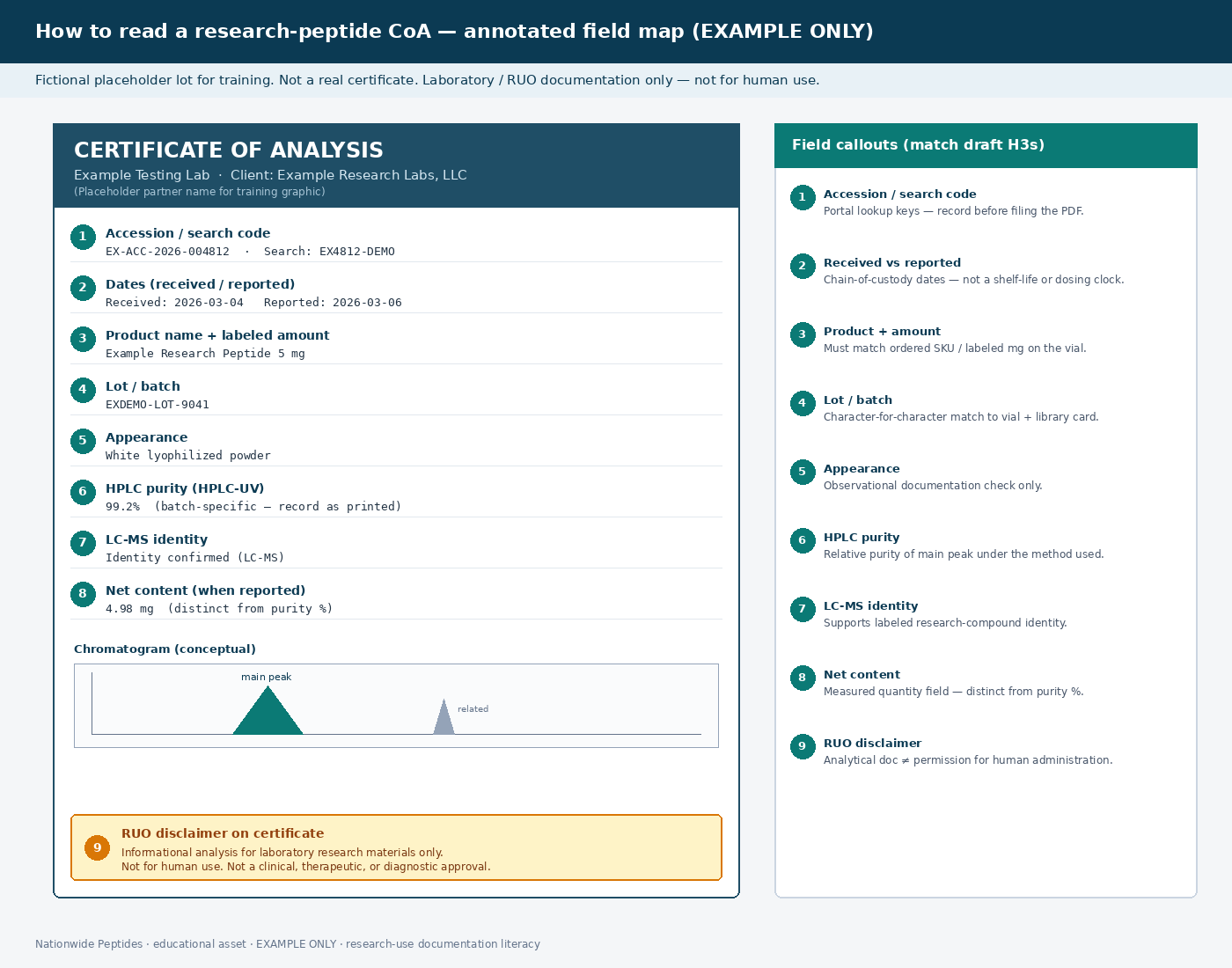
Figure: Annotated CoA field map (EXAMPLE ONLY — fictional placeholder lot). Use with the H3 field walkthrough below. Laboratory / RUO documentation literacy; not a real certificate.
Header & lab identity
Look for issuing lab name and contact (Freedom Diagnostics Testing / FreedomDiagnosticsTesting.com), client name (often National Science Labs, LLC on Nationwide Peptides–related CoAs), and the title Certificate of Analysis.
Accession number & search code
Accession numbers and search codes are the portal lookup keys. Record both in the reagent file before the PDF is archived. You will need them for verification below.
Dates: received vs reported
Received is sample intake; Reported is results issue. Both matter for chain-of-custody and receiving logs. They are not a shelf-life clock and not a dosing calendar—do not invent stability claims from these dates. Storage belongs in laboratory SOPs and site FAQ content.
Product name, lot / batch, and appearance
The product string should match the ordered SKU (name plus labeled amount—for example, a “CJC 1295 DAC 5mg”-style line). Lot / batch must match the vial label and, when published, the matching CoA library card. Appearance often notes lyophilized powder characteristics (for example, white lyophilized powder)—an observational check, not a clinical description.
Sample summary block: purity & net content
When present, purity % is HPLC (HPLC-UV) analytical purity for that tested sample; net content is measured peptide amount in the tested-vial context when reported. Always record the numbers on this CoA. Catalog 99%+ / ≥99% goals describe catalog framing; batch results on /coa/ vary by lot and must be read as printed.
Analytical results table
Tables commonly list Identity (LC-MS), Purity (HPLC-UV), and Net Content when present. Method notes often describe HPLC with UV detection coupled with mass spectrometry (LC-MS). Read the table against the summary block so nothing is filed from memory.
Chromatogram & mass confirmation
The chromatogram is the visual HPLC trace—main peak versus related peaks—that the purity percentage summarizes. Mass confirmation provides LC-MS support for identity. Learn to read those sections (match identity statement and purity % to the table); re-running the assay in-house is out of scope unless your lab already owns a validated method.
CoA disclaimer / RUO statement on the certificate
Freedom Diagnostics–issued CoAs include research-use-only language: informational analysis, not approval for human, veterinary, diagnostic, therapeutic, or clinical applications. Quote that idea when filing; do not invent accreditation badges absent from the certificate or Nationwide Peptides pages.
Step-by-Step: Match the CoA to Your Vial and Order
- Confirm peptide name / SKU on vial vs CoA product line vs order invoice.
- Confirm lot / batch character-for-character (include any
Nati…or numeric prefixes exactly as printed). - Confirm labeled amount (for example, 5 mg vs 10 mg)—the same compound can have multiple CoA cards by size.
- Confirm test / reported date is present and plausible for the batch received.
- Confirm issuing lab is Freedom Diagnostics Testing for Nationwide Peptides third-party CoAs.
- Save PDF + accession / search code in the laboratory’s reagent file.
- Optional: photograph vial label beside CoA header for the receiving packet.
Callout — mismatch: If any identifier disagrees, quarantine the reagent and contact the vendor before use in assays. Keep language laboratory / procurement—not health advice.
HPLC Purity vs LC-MS Identity (What Each Answers)
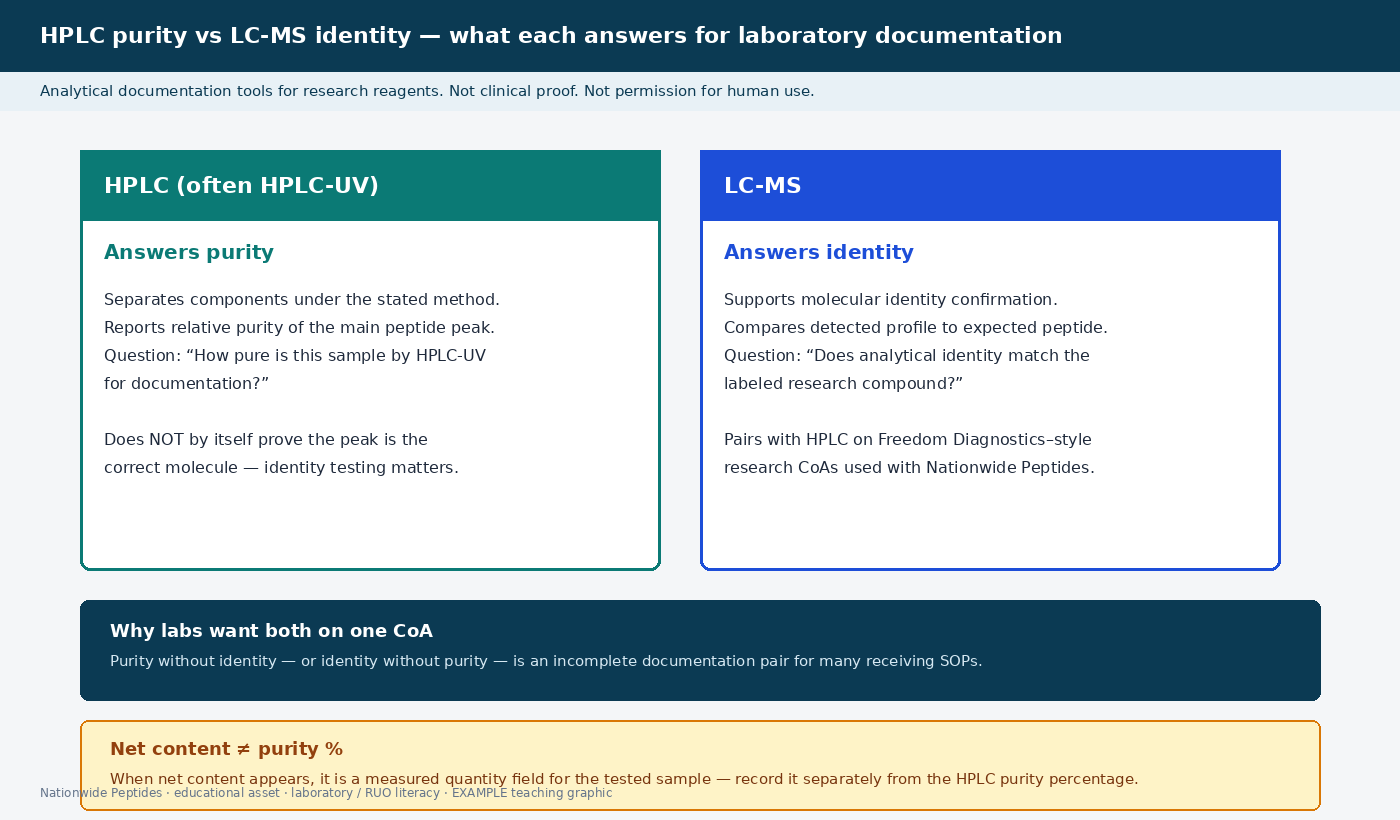
Figure: HPLC purity vs LC-MS identity — analytical documentation pair for laboratory receiving files. Not clinical proof.
What HPLC purity tells investigators
HPLC (often HPLC-UV on Freedom Diagnostics–style reports) separates components and reports relative purity of the main peptide peak under the stated method. It answers: “How pure is this sample by HPLC-UV for documentation?” It does not by itself prove the peak is the correct molecule—that is why identity testing matters.
What LC-MS identity tells investigators
Liquid chromatography–mass spectrometry (LC-MS) supports confirmation that the molecular profile aligns with the expected peptide. It answers: “Does the analytical identity match the labeled research compound?” It pairs with HPLC. Nationwide Peptides /coa/ copy describes HPLC purity and LC-MS identity as sequential steps in the published testing narrative (submit → HPLC → LC-MS → CoA documentation).
Why labs want both on one CoA
Purity without identity, or identity without purity, is an incomplete documentation pair for many receiving SOPs. Point reviewers to the CoA library “How We Test” framing without inventing extra panels. Optional tests (for example endotoxin or heavy metals) may appear upon request or for select compounds where About copy says so—do not imply every CoA includes them.
Net peptide content vs purity % (brief)
When net content appears, treat it as a measured quantity field distinct from purity %. Do not invent conversion formulas or a fillers narrative beyond what the CoA shows. Site messaging about independently verified composition for in vitro studies is a light alignment point only.
How to Verify a Nationwide Peptides CoA at Freedom Diagnostics
Align with the /coa/ “How to Verify” workflow:
- Locate the CoA (library, PDP, or QR).
- Find the Freedom Diagnostics accession number or search code.
- Open the Freedom Diagnostics Testing COA lookup: search by unique accession number (confirm live at publish; the Nationwide Peptides CoA page also points researchers to this platform).
- Enter the verification information.
- Compare the laboratory record to your PDF and vial.
Verification means independent confirmation that the lab issued that accession—not a guarantee of experimental results.
Red flags (factual): wrong client or lot, missing accession, PDF not found in the lab portal, blank purity / identity fields.
Do not import Freedom Diagnostics marketing metrics (turnaround times, public COA counts, “fastest in industry”) unless Madison clears quoting the partner homepage. Nationwide Peptides’ own pages do not need those metrics for this guide.
Micro-CTA: Ready to check a lot? Open the CoA library and match your batch.
Common CoA Reading Mistakes in Laboratory Procurement
- Treating a generic “example CoA” as lot-specific proof → require matching lot.
- Reading only purity % and skipping identity / accession → incomplete file.
- Assuming all sizes of a peptide share one CoA → check size + batch cards on
/coa/. - Confusing catalog “99%+ goal” with the lot’s printed result → always record the CoA value.
- Using CoA language as if it authorized human use → restate the RUO boundary.
- Skipping portal verify because a PDF “looks official” → verify when accession exists.
Quick Lab Checklist (Copy/Paste for Receiving Logs)
- SKU / peptide name match
- Lot / batch match
- Size / labeled amount match
- HPLC purity % recorded from this CoA
- LC-MS identity result recorded
- Accession / search code recorded
- Freedom Diagnostics portal verify completed (date/initials)
- PDF filed with reagent lot
Related Documentation on Nationwide Peptides
- CoA library & verify hub
- Research peptides FAQ
- About research peptides / testing
- Shop research peptides (RUO)
Keep /coa/ as the library hub. This URL owns “how to read”—cross-link both ways at publish.
Soft CTA
Review batch-specific Certificates of Analysis in the Nationwide Peptides CoA library, verify accession codes at Freedom Diagnostics when available, then select research-use-only materials from the shop for your laboratory workflow. For purity and CoA basics, see the FAQ.
For laboratory research use only. Not for human consumption. Not intended to diagnose, treat, cure, or prevent any disease.
FAQ
What is a Certificate of Analysis for research peptides?
A research-peptide Certificate of Analysis (CoA) is batch-specific laboratory documentation that reports analytical results for a tested sample—typically including product identification, lot or batch information, HPLC purity data, and LC-MS identity confirmation. Investigators use CoAs for receiving inspection and research records. Nationwide Peptides CoAs are generated through third-party testing by Freedom Diagnostics Testing and are intended to support laboratory documentation only. They are not clinical approvals and do not authorize human use.
How do I match a CoA to my research-peptide vial?
Compare the peptide name, labeled amount, and lot or batch number on the vial label to the same fields on the CoA and to your order records. Character-for-character lot matching matters; the same compound may have separate CoA entries by size or batch in the Nationwide Peptides CoA library. If any identifier disagrees, quarantine the material for procurement follow-up before using it in assays.
What does HPLC purity mean on a peptide CoA?
HPLC (often HPLC-UV on Freedom Diagnostics–style reports) estimates the relative purity of the main peptide peak under the stated analytical method. The percentage on the CoA is specific to that tested batch and should be recorded as printed. Nationwide Peptides states a catalog purity goal of 99%+ / ≥99%, but laboratory documentation should cite the batch CoA value, not a marketing goal alone.
How do labs verify peptide identity with LC-MS?
Liquid chromatography–mass spectrometry (LC-MS) supports molecular identity confirmation by comparing detected molecular characteristics with expected peptide specifications. On a research CoA, identity results complement HPLC purity: purity describes how clean the HPLC profile appears; LC-MS helps confirm the material aligns with the labeled research compound. Together they form a stronger documentation pair for laboratory receiving files.
How can researchers verify a Nationwide Peptides CoA at Freedom Diagnostics?
Locate the CoA, copy the accession number or search code, open the Freedom Diagnostics Testing COA lookup / verification portal, enter the code, and compare the returned laboratory record to your PDF and vial lot. Nationwide Peptides documents this workflow on its Certificate of Analysis page. Verification confirms the third-party record for that accession; it does not change the research-use-only status of the material.
Where can I download Nationwide Peptides Certificates of Analysis?
Batch-oriented CoA information is published in the public CoA library at nationwidepeptides.com/coa/. FAQ guidance also states researchers may download CoAs from product pages or via peptide-specific QR codes, and may request documentation from [email protected]. Always confirm the lot on the file matches the vial in hand.
Are Nationwide Peptides CoAs third-party documents?
Yes. Nationwide Peptides states that Certificates of Analysis are produced through independent third-party testing performed by Freedom Diagnostics Testing. The CoA is analytical documentation for research materials supplied for laboratory use only—not for human consumption and not intended to diagnose, treat, cure, or prevent disease.
Does a high HPLC purity percentage mean a peptide is approved for human use?
No. Purity and identity results describe analytical characteristics of a research sample under laboratory test methods. Nationwide Peptides products are intended strictly for laboratory research purposes. High purity on a CoA does not mean a compound is a medicine, supplement, or approved therapy, and it must not be interpreted as permission for human administration.
What information commonly appears on a Freedom Diagnostics peptide CoA used with Nationwide Peptides?
Documentation may include peptide name and identification details, batch or lot information, analytical testing dates, purity analysis data, molecular identity confirmation, laboratory verification details, and unique accession or search code information—as described on the Nationwide Peptides CoA page. Individual PDFs can also show appearance, net content, chromatogram, and mass-confirmation sections when those fields are reported for the sample.
What should a lab do if the CoA lot number does not match the vial?
Do not treat the mismatched file as proof for that vial. Segregate the material per your laboratory’s receiving SOP, re-check labels and downloads from the CoA library or product page, and contact Nationwide Peptides customer service with order and lot details. Use only documentation that matches the physical reagent identifiers before releasing material into experimental workflows.